


Global Broker Regulation Inquiry App
About WikiFX
English
简体中文
繁體中文
English
Pусский
日本語
ภาษาไทย
Tiếng Việt
Bahasa Indonesia
Español
हिन्दी
Filippiiniläinen
Français
Deutsch
Português
Türkçe
한국어
العربية
اردو
Why Heavy Position Sizes and FOMO Destroy Beginner Accounts
Abstract:Beginner Forex traders often lose money because they let the Fear Of Missing Out (FOMO) and greed dictate their decisions rather than relying on a solid strategy. This article explains how heavy position sizes destroy emotional control, the danger of relying on intuition over systems, and how trading stress pushes beginners toward scams. The main takeaway is to trade light, build a methodical system, and verify platforms thoroughly.
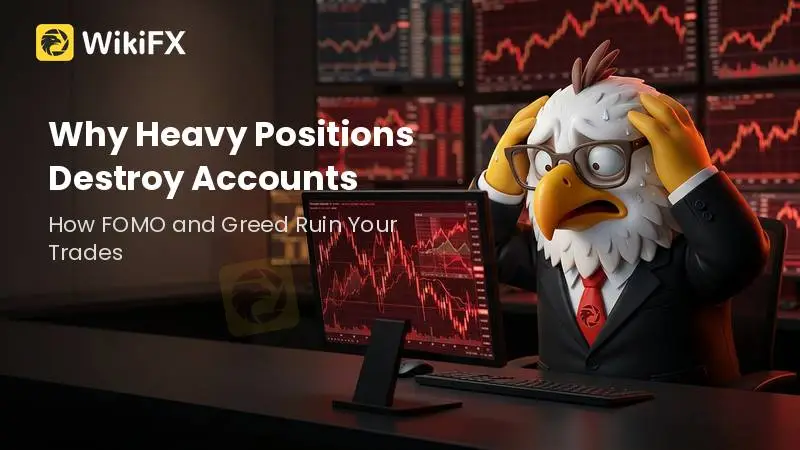
You see a massive upward move on your screen. Your heart races. You jump in, fearing you will miss the profit. Ten minutes later, the market reverses, and you are trapped in a losing trade. This is FOMO—the Fear Of Missing Out—and it is one of the fastest ways to drain your trading capital.
Many new investors assume success relies on finding a secret technical indicator or paying for the perfect trading robot. The reality is that the market is a psychological battleground. Your charting software is just a tool; your mindset dictates whether you survive. If you want to stop entering trades at the wrong time and making impulsive decisions, you have to address the root causes of your trading anxiety.
 Contents
Why heavy position sizes break your mental discipline
Forex trading frequently involves margin, which allows you to control larger positions with a smaller amount of money. While this magnifies potential profits, it also magnifies your psychological stress.
Imagine you have a $5,000 account. If you trade a massive lot size, every tiny price fluctuation creates wild swings in your balance. Under this pressure, your judgment breaks down. When the trade moves slightly in your favor, greed and fear take over—you close it quickly for a tiny profit because you are terrified the market will reverse. But when the trade goes against you, the loss is so large that you freeze. You refuse to cut your losses, hoping the market will miraculously turn around.
Trading light position sizes is the only way to protect your mindset. A smaller position allows you to survive normal market volatility without panicking. It buys you the time and emotional clarity needed to let a proper market trend develop, rather than stressing over every minor dip.
Should you rely on intuition or a trading system?
When beginners face a string of losses, they often try to recover their money instantly by guessing market direction. This often happens around major economic news releases, like the US Non-Farm Payrolls (NFP) data. They see the price shoot up, assume it will keep going, and buy right at the peak.
Trading on pure gut feeling is effectively gambling. A lasting approach requires a defined system that removes emotional guessing. Based on basic trading mechanics, a complete system needs filters and confirmations. A filter keeps you out of random, choppy price movements so you do not mistake a quiet, directionless market for a strong trend. A confirmation tells you to pause; for example, if you want to buy, you wait to see if opposing sellers are stepping in strongly. If the selling pressure is weak, your system confirms it is safer to enter.
Without these rules, you will fall into the trap of overtrading—entering the market simply because you are bored or desperate to flip a losing day into a winning one.
How greed drives beginners toward common scams
When the stress of manual trading becomes too much, many beginners look for an easy way out. They turn to copy trading platforms, expensive seminars, or automated Expert Advisors (EAs).
While EAs can execute trades without human emotion, they are not magic. Many commercial EAs use aggressive averaging or grid strategies that perform well in calm markets but will completely wipe out an account when a strong, unexpected trend occurs. Furthermore, the industry is crowded with bad actors who prey on beginner fatigue. They promise massive returns with zero effort, or run schemes where you provide the capital and take all the risk for a “guaranteed” payout.
If a software seller or account manager promises you high returns with low risk, walk away. In the real market, high returns always involve high risk.
A practical approach to market survival
Your primary goal is not to double your money in a week; it is to protect your capital so you can learn how the market actually moves. Trade only with funds you can afford to lose, keep your position sizes small, and accept that losing trades are a normal business expense.
If you decide to explore automated software, copy trading, or a new broker platform, always do your background research first. You can use the WikiFX app to check a broker's regulatory license, read the fine print on their withdrawal policies, and see actual user complaints. Securing your funds on a legitimate platform gives you one less thing to stress about, allowing you to focus entirely on managing your trades and keeping your emotions in check.

Disclaimer:
The views in this article only represent the author's personal views, and do not constitute investment advice on this platform. This platform does not guarantee the accuracy, completeness and timeliness of the information in the article, and will not be liable for any loss caused by the use of or reliance on the information in the article.
WikiFX Broker
Latest News
Dollar Steadies As US Inflation Reaches 4.20%
 WikiFX
CNMV Warns Against 10 Unauthorized Investment Platforms and Clone Firms
WikiFXFrom Demo to Real Money: Overcoming the Fear of Holding Your First Live Trade
WikiFXWhy Market News and Spread Shocks Sweep Your Stop Loss
WikiFXHow to Place a Forex Stop Loss Using Market Volatility
WikiFXInstaForex Review 2026: Unverified Regulation, Complaints, and High-Leverage Risk
WikiFXDollar Slips on Easing Middle East Tensions
WikiFXWhy Weekend Market Gaps and Swaps Destroy Beginner Accounts
WikiFXCrypto Scam Call Centre Dismantled in Penang as Authorities Intensify Fight Against Cross-Border Fra
WikiFXMing Tak Review 2026: Regulation, Complaints, and Platform Access
WikiFXCurrency Calculator
USD

CNY
Current Rate:0
Enter amount
USD
Redeemable Amount
CNY
Calculate 