


Global Broker Regulation Inquiry App
About WikiFX
English
简体中文
繁體中文
English
Pусский
日本語
ภาษาไทย
Tiếng Việt
Bahasa Indonesia
Español
हिन्दी
Filippiiniläinen
Français
Deutsch
Português
Türkçe
한국어
العربية
اردو
Economic News or Candlestick Charts: Deciding Your First Trading Tool
Abstract:For new Forex traders, deciding whether to follow economic news or memorize candlestick charts can feel overwhelming. This article breaks down the practical differences between fundamental and technical analysis, showing beginners how to combine both for better market timing.
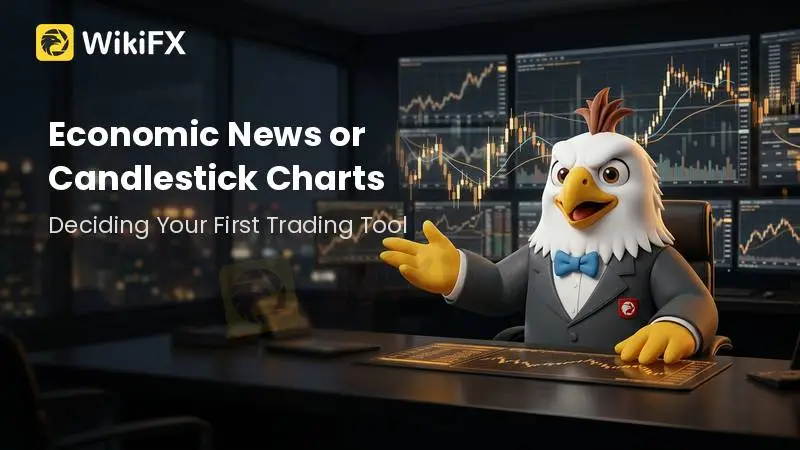
When you first open a Forex trading platform, you are hit with two types of information at once. On one side, you have a calendar full of economic announcements. On the other side, you have price charts filled with red and green bars moving in real time.
For a beginner, the immediate question is always the same: Should I spend my time reading the financial news, or should I focus on learning how to read the price charts?
In Forex, analyzing the news is called fundamental analysis, while studying the charts is called technical analysis. Both have clear roles, and understanding how they differ is the first step toward trading consistently.
 Contents
How Economic News Drives the Big Picture
Fundamental analysis involves looking at the real-world economic data that drives currency values.
Currency prices are heavily influenced by the economic health of the countries that issue them. Traders watch reports like the Consumer Price Index (CPI), the Purchasing Managers' Index (PMI), and employment figures closely. Furthermore, large shifts in the market often happen around central bank meetings, such as the US Federal Reserve (FOMC) announcements on interest rates.
When an interest rate decision drops, it can cause severe volatility, pushing a currency pair sharply up or down within seconds.
However, trading purely on fundamental analysis is complex for beginners. There are dozens of reports released at different times across different time zones. Additionally, these reports are often used to predict long-term trends rather than offering exact instructions on when to buy or sell today. If you enter the market just because the news sounded positive, you might buy at the exact moment the price reverses.
What Candlestick Charts Tell You Right Now
This is where technical analysis comes in. Technical traders use tools like Japanese candlestick charts (sometimes called K-line charts) to read the immediate price action. If news tells you what is happening in the world, candlesticks tell you exactly what buyers and sellers are doing in the market right now.
Each candlestick shows four pieces of data for a specific time period: the open, close, high, and low prices.
- The thick part of the candle is the real body. A green or empty body means the price closed higher than it opened (bullish). A red or filled body means it closed lower (bearish).
- The thin lines on top and bottom are the wicks or shadows. These show the highest and lowest prices reached during that period.
Candlesticks give you immediate visual clues about the psychology of the market. For example, a Marubozu is a long, solid candle with no wicks. It looks like a bald block of color, and it tells you that either buyers or sellers completely dominated the session from start to finish.
On the other hand, a Doji or a spinning top pattern has very long wicks and a tiny body. This indicates indecision. Buyers pushed the price up, sellers pushed it down, but eventually, the price closed almost exactly where it opened. If you see a Doji after a long uptrend, it is often a warning sign that the buyers are exhausted.
The main drawback of candlestick analysis is that the signals are not 100% guaranteed. Because the Forex market operates 24 hours a day, generating massive amounts of data, candlestick charts are highly sensitive. This sensitivity means you will often see false signals.
Why Experienced Traders Rely on Both
Rather than choosing one over the other, most experienced traders develop a strategy that uses a combination of both.
They use fundamental news to understand the long-term trend and technical candlestick patterns to decide exactly when to enter and exit their trades. For instance, if major economic reports suggest a currency should weaken, a smart trader will not sell blindly. Instead, they will pull up their technical charts, wait for the price to correct upward slightly, and look for a bearish candlestick pattern to confirm their entry.
Protecting Your Capital While You Learn
Whether you study news reports or candlestick wicks, you still face the physical risks of the market. During major news releases, price deviations can trigger massive volatility. If you are using standard accounts with high minimums and heavy leverage (where brokers lend you money to magnify your trade size), a sudden spike against your position can wipe out your capital in seconds.
To manage this risk, test your analysis method on a demo account first. This allows you to simulate real trades in a no-pressure environment. Once you are ready for real money, look into starting with a mini account, which allows you to trade much smaller lot sizes ($10,000 instead of the standard $100,000) so you can survive the learning curve.
Finally, keep in mind that execution speed and spread stability during these active periods depend entirely on your broker. Before committing your funds to any platform, take a minute to verify their regulatory license and check their track record on WikiFX to ensure they play by the rules when the market gets busy. Learning to read the market is hard enough; you don't need the added stress of an unreliable broker working against you.

Disclaimer:
The views in this article only represent the author's personal views, and do not constitute investment advice on this platform. This platform does not guarantee the accuracy, completeness and timeliness of the information in the article, and will not be liable for any loss caused by the use of or reliance on the information in the article.
WikiFX Broker
Latest News
CNMV Warns Against 10 Unauthorized Investment Platforms and Clone Firms
 WikiFX
Dollar Steadies As US Inflation Reaches 4.20%
WikiFXFrom Demo to Real Money: Overcoming the Fear of Holding Your First Live Trade
WikiFXWhy Market News and Spread Shocks Sweep Your Stop Loss
WikiFXHow to Place a Forex Stop Loss Using Market Volatility
WikiFXWhy Weekend Market Gaps and Swaps Destroy Beginner Accounts
WikiFXDollar Slips on Easing Middle East Tensions
WikiFXInstaForex Review 2026: Unverified Regulation, Complaints, and High-Leverage Risk
WikiFXMing Tak Review 2026: Regulation, Complaints, and Platform Access
WikiFXCrypto Scam Call Centre Dismantled in Penang as Authorities Intensify Fight Against Cross-Border Fra
WikiFXCurrency Calculator
USD

CNY
Current Rate:0
Enter amount
USD
Redeemable Amount
CNY
Calculate 