

Global Broker Regulation Inquiry App
About WikiFX
English
简体中文
繁體中文
English
Pусский
日本語
ภาษาไทย
Tiếng Việt
Bahasa Indonesia
Español
हिन्दी
Filippiiniläinen
Français
Deutsch
Português
Türkçe
한국어
العربية
اردو



Spreads, Swaps, and B-Books: The Real Cost of Trading Forex

WikiFX
|


Abstract:A practical breakdown of the hidden costs in Forex trading, explaining why trades start in the negative. It helps beginners understand spreads, swaps, and the critical difference between A-Book and B-Book execution to avoid high-rebate scams.
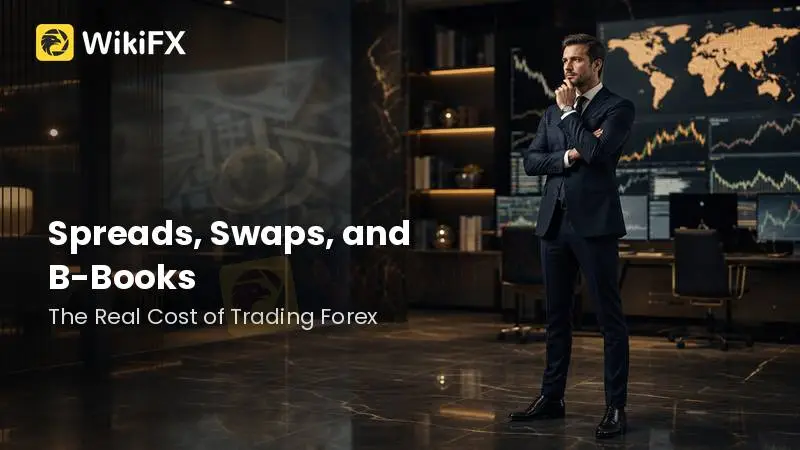
Every time you click “buy” or “sell” on your trading platform, your position instantly starts in the negative. For many beginners, this is a stressful moment. It feels like the market is already moving against you. In reality, you are just paying the baseline costs of entering a trade.
If you do not understand where this money goes and how brokers actually operate, it becomes very easy to fall into the trap of “zero spread” scams or shady platforms. Here is a look at the actual mechanics of Forex pricing and what you are really paying for.
 Contents
The Big Three: Spreads, Commissions, and Swaps
Whenever you trade, the platform is providing a service, and they do not do it for free. Your baseline costs come in three forms.
The Spread
When you look at a currency pair, you will see two prices: the buy price and the sell price. The difference between them is the spread. If the market price is 1.3000, your broker might quote you 1.3002 to buy. That small markup is the spread, and it is immediately deducted the second your trade opens. This is the primary way brokers make their money.
Commissions
Some accounts offer extremely tight or even “zero” spreads, usually labeled as ECN or STP accounts. Because they are not marking up the spread, they charge a flat commission fee instead. For example, you might pay a few dollars for every standard lot (100,000 currency units) you trade.
Overnight Swaps
If you open a trade and close it a few hours later, you do not worry about this. But if you hold a position overnight, you will incur a swap fee. This is heavily tied to the interest rate difference between the two currencies you are trading. Depending on your position, you might earn a tiny bit of interest, or pay a small fee to hold the trade into the next day.
A-Book vs. B-Book: How Your Broker Operates
The fees you pay also depend heavily on the type of system your broker uses behind the scenes. The industry generally splits into two models: A-Book and B-Book.
A-Book Execution
An A-Book broker acts purely as a middleman. When you place an order, they route it directly to external liquidity providers, like major banks or financial institutions. Because they match your order with the real market, they do not care if your trade wins or loses. The broker profits purely from the spread markup or the commission you pay. This model offers high transparency, but trading costs can sometimes be higher, and spreads may widen unexpectedly during major news events.
B-Book Execution
A B-Book broker takes the opposite side of your trade. If you buy, they are the ones selling to you. This is also known as a market maker model. Because they act as the counterparty, your trading losses become the brokers direct profit.
While this sounds like a massive conflict of interest, B-Book models allow brokers to offer beginner-friendly features like micro-accounts with very low minimum deposits, high leverage, and fixed spreads. The danger arises when a poorly regulated B-Book broker aggressively manipulates price feeds to ensure their clients lose.
The “Zero Cost” and High Rebate Traps
Once you understand that brokers survive on spreads, you can spot bad deals quickly.
You will often see introducing agents offering massive “rebates” (cashback) to get you to open an account under their link. While rebates are a normal part of the industry, aggressively high rebates often mask a problem. The agent gets paid a cut of your spread from the broker. If an agent is offering you unusually high cash returns, you are likely trading on an account with artificially inflated spreads. Your trading costs are simply being hiked up to pay for your own rebate.
Even worse is the promise of “zero spread and zero commission.” The financial market is not a charity. Running servers, connecting to banks, and staffing a platform requires heavy funding. If a platform literally charges you nothing to trade, they are running a pure B-Book scam designed to swallow your entire deposit.
Checking the Foundation Before You Trade
Before you deposit serious capital, you need to know how the platform handles your cash.
The standard for safety is the “segregated account.” This means the broker keeps your trading deposit in a separate trust bank account, completely walled off from their own corporate operating funds. If the brokerage goes bankrupt, your money cannot be used to pay off their business debts.
This is why regulatory licenses matter. For example, under the UKs FCA, a broker holding a “basic license” is legally not allowed to hold client money. They must secure a “full license,” which requires massive capital reserves, to handle retail funds safely.
Before you commit funds to a new platform, take a moment to look up their exact regulatory standing on the WikiFX app. Verify if their specific license actually permits them to hold client money, and always test the broker with a small deposit and withdrawal to ensure the process is smooth before trading larger amounts.

Disclaimer:
The views in this article only represent the author's personal views, and do not constitute investment advice on this platform. This platform does not guarantee the accuracy, completeness and timeliness of the information in the article, and will not be liable for any loss caused by the use of or reliance on the information in the article.
WikiFX Broker
Latest News
Traze Review: What Traders Should Know Before Depositing
WikiFXMatch-Trade Gives AI Direct Access to Broker Trading APIs
WikiFXWhy Sovereign Debt Can Sink a Currency: The Credit Risk Channel
WikiFXUS July CPI Could Take a Fed Rate Hike Off the Table
WikiFXEMAR MARKETS Review 2026: Severe Withdrawal Complaints and Risk Signals
WikiFXBYBIT Review: What Traders Should Know Before Depositing
WikiFXPocket Broker Review: What Traders Should Know Before Depositing
WikiFXIC Markets Global Review for South Asian Traders: A Global License Isn't the Same as Local Permit
WikiFXTrader's Way Review: Trades Vanished Overnight , And There's No Regulator to Call
WikiFXLockwood Review: AMF-Blacklisted Broker with Users Reporting Blocked Withdrawals
WikiFX