

Global Broker Regulation Inquiry App
About WikiFX
English
简体中文
繁體中文
English
Pусский
日本語
ภาษาไทย
Tiếng Việt
Bahasa Indonesia
Español
हिन्दी
Filippiiniläinen
Français
Deutsch
Português
Türkçe
한국어
العربية
اردو


RaiseFX Review: Regulation Red Flags Around This Broker

WikiFX
|


Abstract:RaiseFX carries a severe warning profile: traders report frozen or banned accounts, disputed withdrawal deductions, and a 20% penalty on returned deposits, while European regulators list unauthorized activity. For retail Forex traders, the danger is not theoretical—it is showing up in account access and withdrawal complaints.
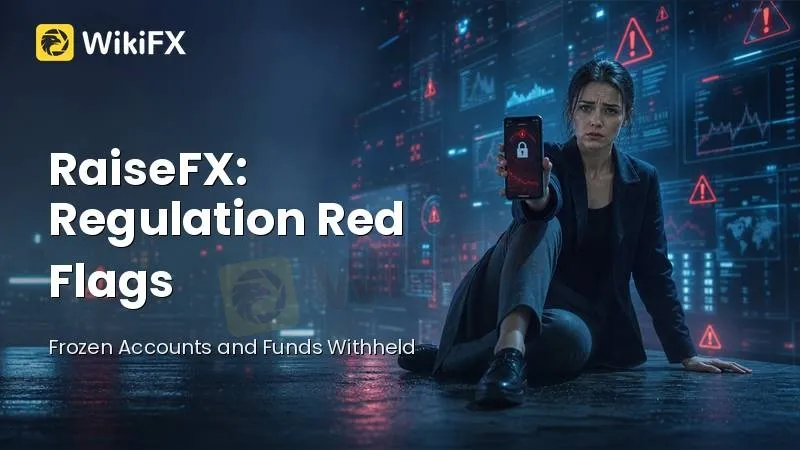
A trader says a simple withdrawal turned into a fight over missing money. They withdrew $44 and say only $34 arrived. When they challenged the explanation, they were first told it was an ERC20 network charge—then said they had actually used TRC20.
That detail matters. The trader says RaiseFX later called it a “normal, new fee,” even though they claimed they had used the broker since March 2025 without seeing that deduction before. A second withdrawal of $178 allegedly arrived as $175. The pattern was smaller the second time, but the concern was bigger: fees that changed explanation when questioned.
This RaiseFX review is not built on marketing claims. It is built on trader complaints and regulatory records. Our investigation reveals a broker profile with serious pressure points: disputed withdrawals, account freezes, banned access, privacy concerns, and warnings from major European authorities.
 Contents
RaiseFX Regulation Audit: What the Records Actually Say
The regulation picture is mixed—and that is exactly why traders need to slow down. RaiseFX is linked to South Africas FSCA records, but one FSCA-linked entry is marked “Unverified.” At the same time, regulators in Spain and France have issued warnings or listings tied to unauthorized service activity.
| Regulator | License Type | REAL STATUS |
|---|---|---|
| South Africa FSCA | Financial services record for INSELE CAPITAL PARTNERS, No. 50455 | Unverified |
| South Africa FSCA | Financial services record for RAISE GLOBAL SA (PTY) LTD, No. 50506 | Regulated |
| Spain CNMV | Public warning regarding investment services and activities, including Forex-related financial instruments | Unauthorized |
| France AMF | Forex blacklist for unauthorized companies and websites | Unauthorized / Blacklisted |
| France AMF | Authority warning list covering unauthorized websites or entities offering services in France | Unauthorized warning |
The Spanish CNMV warning is especially direct. It states that https://RaiseFX.com / RaiseFX is not authorized to provide restricted investment services and activities under Spains securities market and investment services law, including financial instruments involving foreign exchange trading.
Frances AMF also appears in the record. One entry places the entity or website on an unauthorized Forex blacklist. Another warning explains that unauthorized sites and entities may offer services without approval, and urges the public to check official registers.
So the key question is simple: if a broker is marketed across borders, but major European regulators warn that it is not authorized in their jurisdictions, what protection does an everyday trader really have when something goes wrong?
RaiseFX Broker Complaints: Frozen Accounts, Bans, and Funds Withheld
The most alarming complaints are not about spreads or platform design. They are about access to money.
One trader in Australia reported that their account was frozen after RaiseFX alleged arbitrage activity. The trader says no substantial proof was provided despite repeated requests. They also claimed they showed evidence that the account had been in loss for three months, that only 51% of trades were winning, and that trades had a long duration.
The same complaint raises another serious issue: personal and trading information. The trader alleged that RaiseFX shared their personal and trading data with other brokers. That is not a minor customer-service dispute. If accurate, it would create risk around confidentiality and data protection.
Then came the financial pressure point. The trader says RaiseFX offered to return the initial deposit but imposed an arbitrary 20% penalty. In plain English: the trader says they could get some money back, but only after accepting a cut.
A German complainant described a similar pattern. They said RaiseFX accused them of arbitrage without concrete evidence, banned the account, froze the remaining balance, and applied a 20% penalty to withdraw the initial deposit. The trader also claimed that more than $3,000 was deleted across two accounts.
A Thailand-based complaint repeated the same structure: alleged arbitrage accusation, account freeze, remaining balance locked, and a 20% withdrawal penalty on the initial deposit. The wording is nearly identical in parts to the German report, but the complaint still reinforces a recurring theme: traders say the broker uses internal rule accusations to control access to funds.
RaiseFX Login and Account Access Issues Exposed
The login risk here is not described as a password reset problem or a technical outage. It is more serious. Traders report account bans, frozen balances, and blocked access to funds after internal accusations.
A Belgium-based trader wrote in French that everything had been fine, then the account was allegedly banned because the trader was Belgian. The trader said they had started with 150, built gains from BTC trading, and had more than 5k in gains plus more than 5k unrealized in open positions. They asked RaiseFX to pay the gains and said they would follow up after contacting support.
Another Belgium-related complaint, posted the next day, says support guaranteed the withdrawal of funds totaling 6,922 euro despite a regulation problem in the traders country. That post is more hopeful in tone. But it still reveals something important: regulation restrictions and user access were active issues in the customer experience.
For a retail Forex trader, blocked access can be devastating. A trading account is not just a dashboard. It holds capital, open positions, transaction records, and withdrawal rights. When access is frozen or banned, the trader is forced into the brokers dispute process—and loses practical control.
Withdrawal Deductions and Penalties: The Cost Traders Say They Faced
The 2025 withdrawal complaint is different from the 2024 account-freeze cases, but it points in the same direction: money leaving the traders control under disputed explanations.
The trader said $10 disappeared from a $44 withdrawal. Then $3 disappeared from a $178 withdrawal. RaiseFX allegedly changed the explanation after the trader provided proof that the withdrawal route was TRC20, not ERC20.
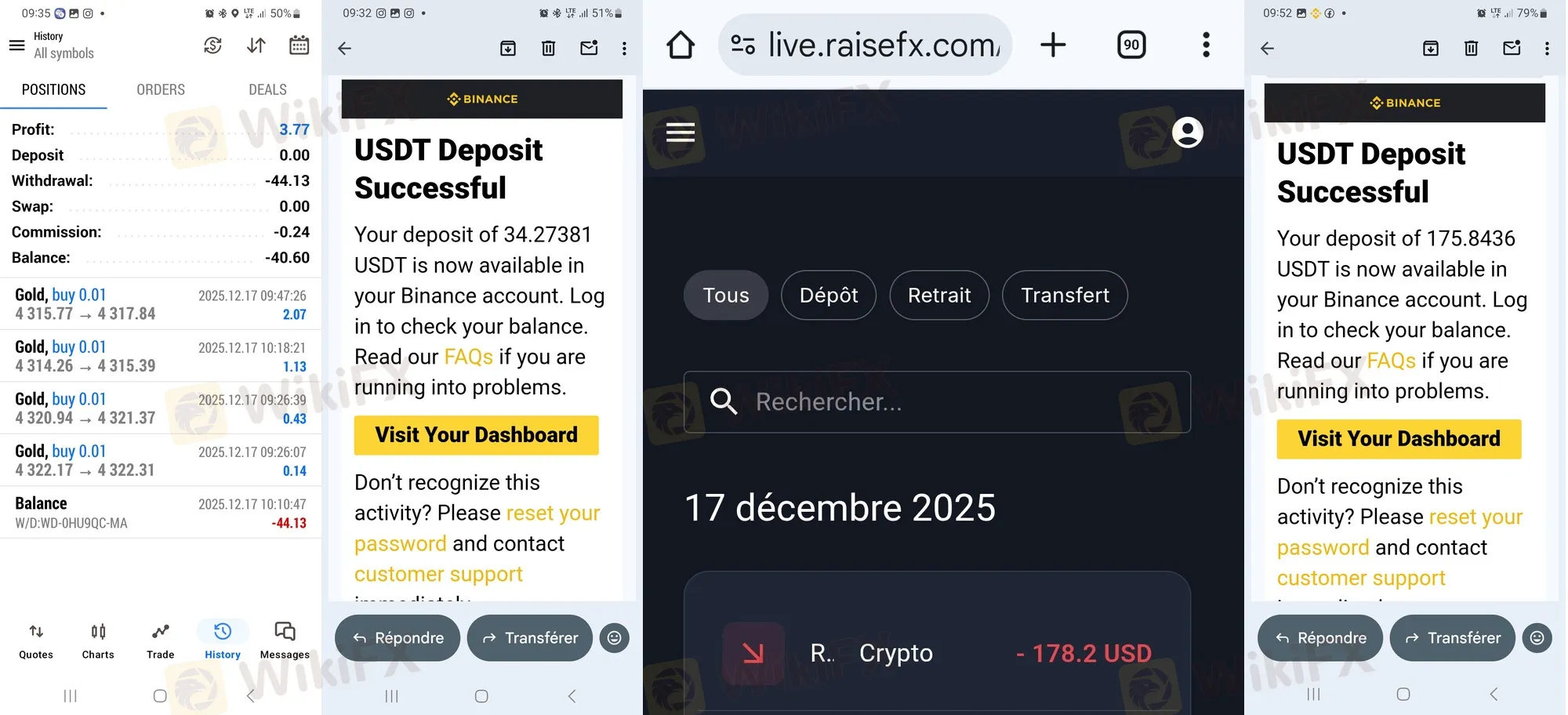
This matters because withdrawal transparency is one of the clearest tests of a broker. Fees can exist. Network costs can exist. But traders need clear terms, consistent explanations, and predictable deductions before they submit a withdrawal request.
When a broker changes the reason for a deduction after being challenged, trust collapses. When that happens alongside older complaints about frozen balances and 20% penalties, the concern becomes much harder to dismiss as a one-off support error.
Key Red Flags for RaiseFX Forex Traders
- European unauthorized warnings: Spain‘s CNMV states RaiseFX is not authorized to provide restricted investment services, including foreign exchange-related instruments.
- AMF blacklist exposure: France’s AMF record includes RaiseFX in unauthorized Forex-related warnings.
- Account freeze and ban complaints: Traders reported frozen accounts, banned access, and withheld remaining balances after alleged arbitrage claims.
- Disputed money handling: Complaints include a 20% penalty on returned deposits and unexplained withdrawal deductions.
Visual Evidence Review
The complaint file includes image links attached to several 2024 and 2025 reports. Because there are no current-year complaint items in the supplied record, no current-year visual evidence placeholders are inserted here.
Still, the presence of attached complaint images from prior years strengthens the need for traders to preserve evidence. Screenshots of withdrawal requests, fee explanations, account status messages, and support responses can become critical when a broker dispute escalates.
Is RaiseFX Broker Safe? The Verdict
RaiseFX presents a high-risk profile for retail traders. The company has an FSCA-regulated entry connected to RAISE GLOBAL SA (PTY) LTD, but that does not erase the “Unverified” FSCA-linked record, the CNMV unauthorized warning, or the AMF blacklist exposure.
The user complaints are equally serious. Traders describe blocked access, frozen balances, banned accounts, disputed arbitrage accusations, privacy concerns, withdrawal deductions, and penalties on deposits. These are not cosmetic issues. They strike at the core of broker safety: can a trader access funds and receive clear, fair treatment when there is a dispute?
Our conclusion is direct. Any trader considering RaiseFX should verify authorization in their own jurisdiction before depositing, read withdrawal and fee terms closely, and avoid keeping more capital on the platform than they can afford to have delayed or disputed. In Forex trading, market risk is already enough. You should not have to battle your broker just to reach your own money.

Disclaimer:
The views in this article only represent the author's personal views, and do not constitute investment advice on this platform. This platform does not guarantee the accuracy, completeness and timeliness of the information in the article, and will not be liable for any loss caused by the use of or reliance on the information in the article.
WikiFX Broker
Latest News
LQH MARKETS Review: Multiple Traders Report Withdrawals Blocked and Accounts Terminated
WikiFXSpread Cheating: The Invisible Trading Cost That Could Be Working Against You
WikiFX"They Want to See Your Face": Inside ATFX Cambodia's Rise
WikiFX57 Booked in Pune Forex Scam Probe: The Fake Trading App Checklist Every Indian Investor Needs
WikiFXAccused of a RM123 Million Crypto Scam, He Fled to Malaysia and Claimed He Was Robbed
WikiFXAfrica's 10 Strongest Currencies in July 2026: Naira Absent
WikiFXU.S. and Japan Stand Ready for Further Coordinated Yen Intervention, Treasury Warns
WikiFXMarket, Limit, and Stop Orders in Forex Explained Simply
WikiFXSri Lanka Rupee Slides 7.9% in H1 2026 as Bank Steps In
WikiFXHF Market Review – A 1.76 Score, an Unverified CYSEC Licence, and a Frozen Account
WikiFX