

Global Broker Regulation Inquiry App
About WikiFX
English
简体中文
繁體中文
English
Pусский
日本語
ภาษาไทย
Tiếng Việt
Bahasa Indonesia
Español
हिन्दी
Filippiiniläinen
Français
Deutsch
Português
Türkçe
한국어
العربية
اردو


Why Prices Rush Back to Fill Gaps: Liquidity Voids Explained

WikiFX
|


Abstract:Explains how order flow gaps form liquidity voids and imbalance zones, and why price often returns to fill them – with a clear hypothetical EUR/USD example. No trading advice, just understanding market microstructure.
 Contents
What Are Liquidity Voids and Imbalances?
In a fast-moving market, when one side pushes aggressively, price can skip over a cluster of price levels in a fraction of a second. Those skipped levels, where almost no trading occurred, form a liquidity void. The imbalance comes from the order flow: aggressive market orders consumed all available limit orders within that range, and because no resting orders were left, price had to jump to find the next batch of liquidity. Later, when the impulsive force fades, price often revisits that void. This revisit is not a magnetic law but the market searching for two-sided liquidity to rebalance the auction.
How Order Flow Creates These Zones
Order flow is the river of market orders (which take liquidity) and limit orders (which provide liquidity). In a normal market, limit orders are stacked at successive price levels. When a burst of aggressive buy or sell orders rips through the order book faster than new limit orders can refill, the price leaps. The levels that got skipped, with few or no trades printed, are the imbalance zone. Once the aggressive buying or selling stops, the market often drifts back to test those empty levels. There, lingering limit orders may still be waiting, or new participants step in, effectively filling the void with trades.
A Hypothetical Forex Example
Suppose EUR/USD is trading in a tight range between 1.1400 and 1.1420. An unexpectedly strong economic release hits, triggering a wave of euro buying. Aggressive market buy orders absorb every sell-side limit order from 1.1420 straight up to 1.1480, with almost no trades printing in between. The 60-pip gap is a liquidity void. Minutes later, the buying pressure subsides. Price slowly slides back through 1.1460 and 1.1440 before touching the 1.1420 zone. This return fills the void. The move appears like a magnet, but it's simply the market restoring two-way flow: sellers see an opportunity at levels that were rushed through, and buyers who missed the initial spike step in.
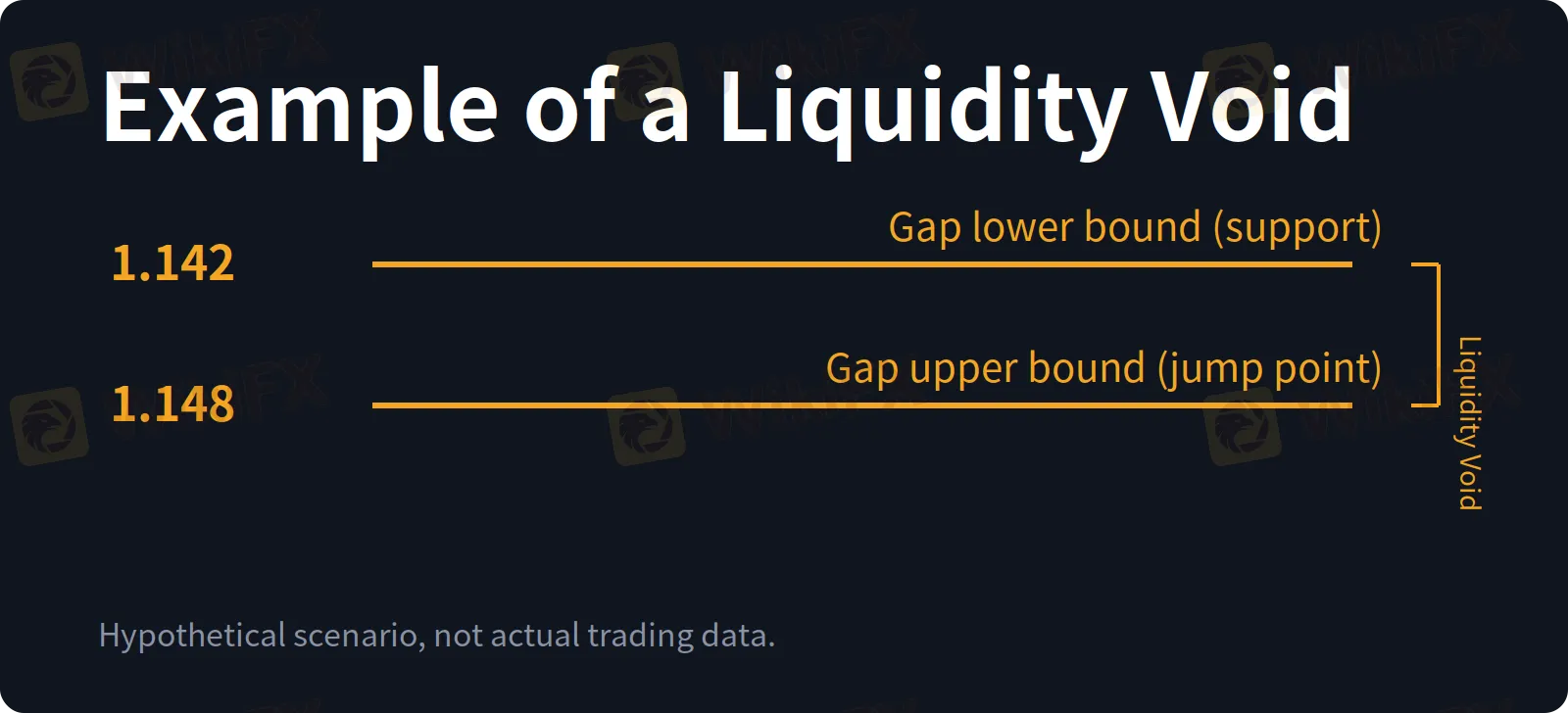
A price jump leaves a void that later attracts price back.
Common Misconceptions: Magnetism Is Not Magic
- “The gap will always be filled.” Not true. In a strong trend, a void can stay open for a long time, and price may never fully retrace to every level.
- It's not a magnet. Price revisits because of order flow dynamics, not an invisible force. If fresh liquidity doesn't materialise at the old skipped levels, the void may remain unfilled.
- Every fast move is not a void. A real liquidity void requires an actual absence of trading at specific price levels; a simply rapid move with small but continuous prints is not the same.
What They Indicate – and What They Don't
Liquidity voids and imbalances are valuable markers of moments when supply and demand were severely disjointed. They help us understand market microstructure and the behaviour of aggressive participants. They are not mechanical predictors: they tell you nothing about future direction, do not guarantee a fill, and do not define whether a trend will continue or reverse. Treat them as part of the market's story, not as a trading signal.
Disclaimer:
The views in this article only represent the author's personal views, and do not constitute investment advice on this platform. This platform does not guarantee the accuracy, completeness and timeliness of the information in the article, and will not be liable for any loss caused by the use of or reliance on the information in the article.
WikiFX Broker
Latest News
How Trading Costs Quietly Drain Your Account: Spreads, Swaps, and Pip Values
WikiFXWhy MetaTrader 4 Remains the Top Choice for Testing Automated Trading Robots
WikiFXeFishery Founder Jailed Nine Years as KWAP Defends RM163 Million Loss
WikiFXGFS Review 2026: Withdrawal Complaints, MT5 Access, and Regulation Gaps
WikiFXLOYAL PRIMUS Review: FSCA-Regulated Broker Faces Mounting Withdrawal Complaints
WikiFXDollar Firms as Geopolitics Pressures Asian Currencies
WikiFXKASPER CAPITAL MARKETS Review 2026: Regulation, Safety, and User Feedback
WikiFXThings About HTFX Broker That You Don't Know About
WikiFXWhy Most Retail Traders Fail: What the Numbers Reveal
WikiFX22K Trader Review 2026: Ongoing User Allegations Raise Fresh Questions About Trust
WikiFX