

Global Broker Regulation Inquiry App
About WikiFX
English
简体中文
繁體中文
English
Pусский
日本語
ภาษาไทย
Tiếng Việt
Bahasa Indonesia
Español
हिन्दी
Filippiiniläinen
Français
Deutsch
Português
Türkçe
한국어
العربية
اردو


Why Importers Panic When Dollars Dry Up, and Why You Should Care

WikiFX
|


Abstract:A dollar liquidity shortage is not a currency collapse. This article explains how tight dollar access flows from importers to banks to ordinary consumers, and how to read the import cover measure without mistaking it for trading advice.

 Contents
What a Dollar Liquidity Shortage Is
A dollar liquidity shortage means US dollars are hard to obtain quickly and at a reasonable cost inside a banking system or market. It does not mean a country has zero dollars; it means the usual channels for getting dollars are blocked, slow, or much more expensive. The shortage is about access and timing, not only about total reserves.
Importers are businesses that buy goods from abroad and often must settle invoices in dollars. Banks act as the middle layer that provides dollar accounts, letters of credit (bank guarantees that a supplier will be paid once goods are shipped), and foreign exchange to those importers. Ordinary consumers feel the effect later, through higher prices for imported goods, job losses in importing businesses, and shortages of certain products.
A dollar liquidity shortage is a payment constraint. It is not a forecast of any currency's direction and not a signal to enter any trade.
The Underlying Idea: Liquidity and the Reserve Currency
Liquidity is the ease of converting an asset into cash without causing a large price move. For a currency, it means you can buy or sell it with low transaction cost and stable price. The US dollar is the world's main reserve currency: central banks hold it as a store of value and for international payments.
Many importers in African economies invoice goods in dollars even when trading with non-US partners, because suppliers accept the dollar widely. This creates structural demand for dollars that is separate from demand for the local currency. Banks also need dollar liquidity to meet customer withdrawals and trade finance (short-term funding that keeps imports and exports moving).
When global dollar funding conditions tighten, correspondent banks (foreign banks that provide dollar accounts and payment services to local banks) may reduce credit lines to local banks. That reduces the local supply of dollars and triggers the shortage described above.
How a Shortage Shows Up in Numbers
Official foreign exchange reserves are the foreign currency assets a central bank holds, mostly in US dollars. One rough measure of dollar liquidity pressure is import cover. The formula is:
Import cover (months) = official foreign exchange reserves in USD ÷ average monthly import bill in USD
This shows how many months a country could keep paying for imports at the current rate if no new dollar inflows arrived. The calculation follows three steps:
- Identify the official foreign exchange reserves in US dollars from the central bank balance sheet.
- Estimate the average monthly import bill, usually total imports over a year divided by 12.
- Divide the reserves by the monthly import bill to get import cover in months.
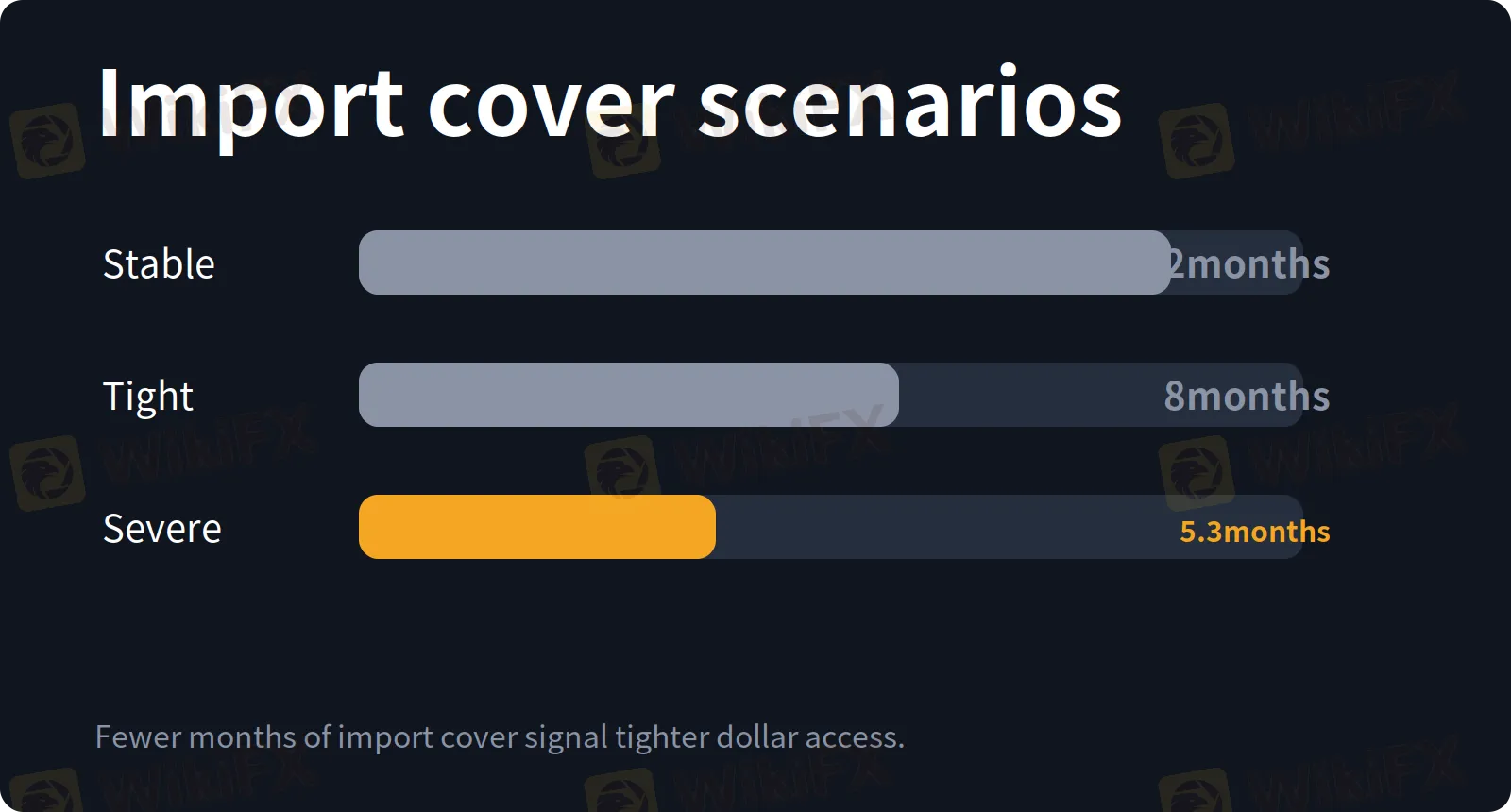
Hypothetical import cover in months, rounded from the example above.
Common Misunderstandings and Limits
Beginner readers often misread a dollar liquidity shortage in predictable ways. Here are four:
- A shortage does not mean there are no dollar reserves. It can be a timing, maturity, or access problem, even when headline reserves look large.
- A falling local currency is not the same as a dollar liquidity shortage. The exchange rate can move for many reasons, while liquidity is about the ability to settle dollar payments.
- Headline central bank reserves do not tell the whole story. Private bank dollar deposits and external credit lines from correspondent banks also matter.
- Import cover is a rough indicator, not a precise trigger. Different economies have different buffer needs and debt structures, so the same number of months can mean different things.
The import cover formula also ignores short-term external debt repayments, remittance inflows, and private sector dollar holdings. It can overstate or understate actual stress. Exchange rate depreciation can create currency risk, but it is a symptom, not the shortage itself.
What It Is and What It Is Not
A dollar liquidity shortage is a constraint on access to dollars for settling invoices, meeting bank obligations, and keeping imported goods flowing. It is not a prediction of exchange rate direction, not a recommendation to buy or sell any currency, and not a statement that a country is bankrupt.
For importers, the shortage shows up as delayed payments or higher dollar funding costs. For banks, it shows up as tighter dollar credit and reduced ability to support trade finance. For ordinary consumers, it eventually shows up as higher prices for imported goods and pressure on household budgets.
Understanding this channel helps readers separate a real payment problem from a mere price move in the foreign exchange market. The two can happen together, but they are not the same thing.
Disclaimer:
The views in this article only represent the author's personal views, and do not constitute investment advice on this platform. This platform does not guarantee the accuracy, completeness and timeliness of the information in the article, and will not be liable for any loss caused by the use of or reliance on the information in the article.
WikiFX Broker
Latest News
Match-Trade Gives AI Direct Access to Broker Trading APIs
WikiFXTRADEVIEW MARKETS Review: Broker Complaints, Regulation Warnings, and Funds Withheld Claims
WikiFXCrypto Revenue Falls in Q2 as Another Platform Moves Into CFDs
WikiFXVestrado Review: A 4.84 Score, an Offshore Base and an FSCA Status Worth Verifying
WikiFXCore Prime Review 2026: Unregulated Status, Blocked Accounts, and Key Risks
WikiFXUS July CPI Could Take a Fed Rate Hike Off the Table
WikiFXWhy Sovereign Debt Can Sink a Currency: The Credit Risk Channel
WikiFXCrypto Platform YEPBIT Got Shutdown by Australian Regulators
WikiFXUS PPI Cools, but the Core Number Tells a More Complicated Story
WikiFXIslami Bank suspends officer who filed ACC loan-fraud case
WikiFX