Abstract:Read this amana review covering broker regulation, user complaints, and withdrawal risk signals on WikiFX before you deposit. Check the facts now.
 Contents
Amana Review: Regulation, Complaints, Withdrawal Risk
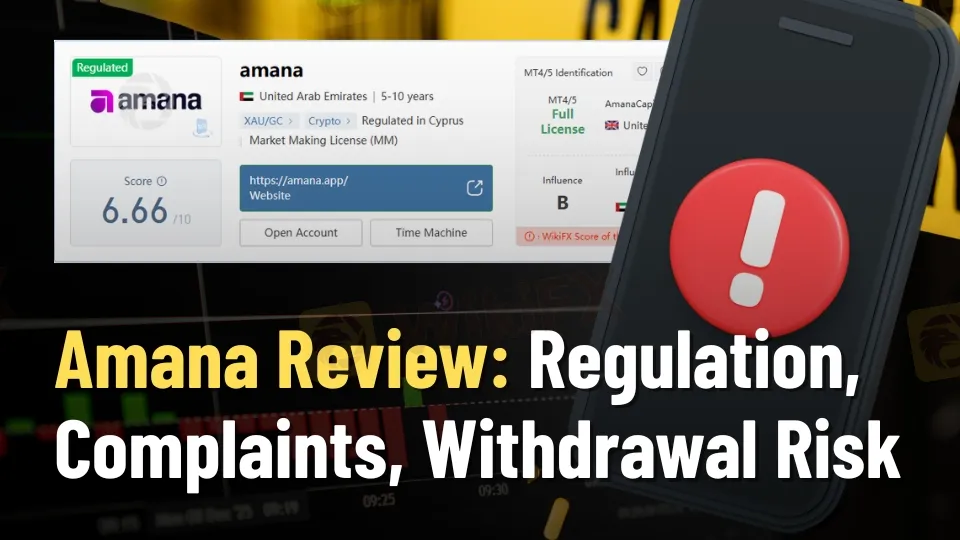
If you are researching whether amana is safe to fund, the most important signal on its WikiFX page is that the profile is not cleanly positive. The broker is shown as regulated, but the page also says its WikiFX score was reduced because of too many complaints, and the risk alert warns that WikiFX has received user complaints against it.
That is why this amana review needs to look past the headline label. For traders using the WikiFX App to check broker regulation, user complaints, and possible withdrawal problems, the more revealing details sit in the review feed and warning notes rather than in the top badge alone. (WikiFX)
Amana Broker Overview
The source page identifies amana as Amana Capital Ltd, with the registered region listed as the United Arab Emirates and an operating period of 5–10 years. It also shows the company website as amana.app, the support email as support@amana.app, the contact number as +97142769525, and MT4/MT5 identification marked as full license.
In its company summary, amana presents itself as a multi-asset broker offering forex, commodities, stocks, cryptocurrencies, ETFs, indices, and metals. The same section says the broker supports the amana App, amana Web, MT4, and MT5, while offering leverage up to 1:100 and live chat support.
Broker Regulation Needs Closer Review
One reason amana may appeal to traders is that the license display on the page shows CySEC, DFSA, and Lebanons CMA as regulated. The page also labels these as Cyprus Market Making License, United Arab Emirates Derivatives Trading License, and Lebanon Derivatives Trading License, which gives the broker a stronger first impression than an outright unlicensed firm.
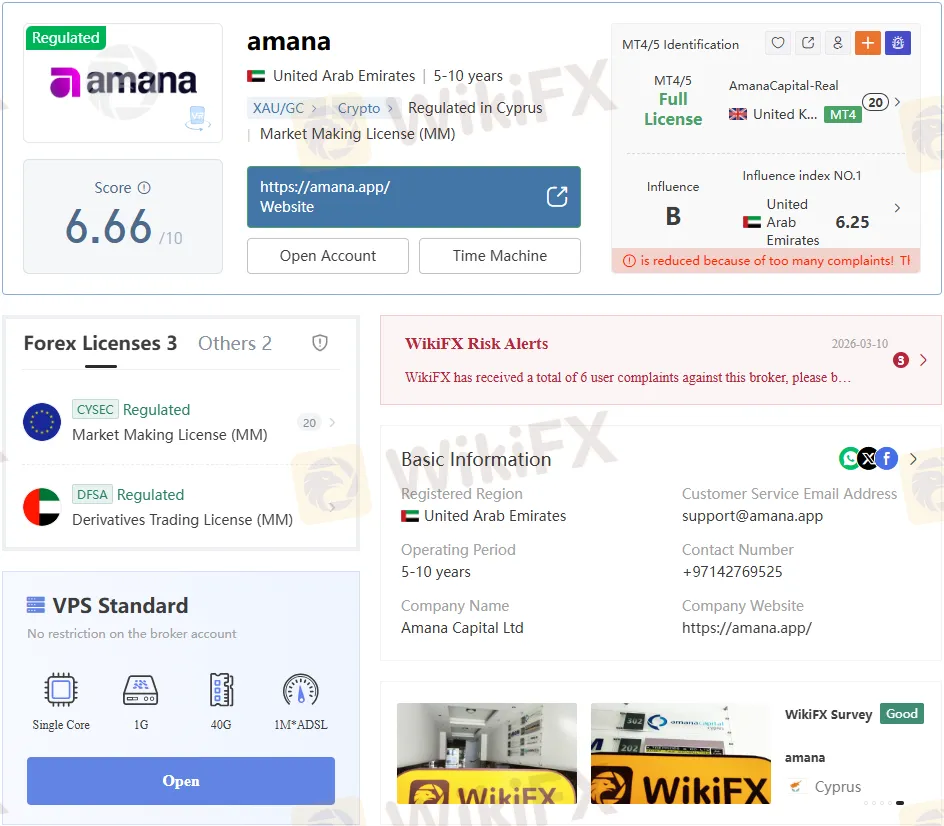
However, the same source page also introduces a more complicated regulatory picture. In the company summary, DFSA and CMA are shown as regulated, but BDL is listed as revoked, SCA as exceeded, and CySEC/FCA as suspicious clone, which means traders should verify the exact entity behind their account instead of relying on the brand name alone.
That mixed regulatory presentation does not automatically prove scam conduct, but it does raise the standard of due diligence. When a broker page shows both regulated entities and clone, exceeded, or revoked flags, the safer reading is that broker regulation must be checked at the entity level before any deposit is made.
User Complaints Highlight Withdrawal Problems
The bigger concern comes from the complaint pattern. The page states that the WikiFX score is reduced because of too many complaints, the risk alert says WikiFX has received 6 user complaints against the broker, and the user review section shows 16 reviews in total, including 8 exposure posts.
Several of those exposure posts revolve around withdrawal problems. One user says, “my withdrawals were blocked,” while another says the platform would not allow withdrawal of trading earnings and that repeated emails received no response.
The complaints do not stop there. Another exposure says a third withdrawal attempt led to an account freeze and a demand to deposit the same amount within a deadline, while another claims withdrawal required a gold-member upgrade and additional recharge conditions before money could be released.
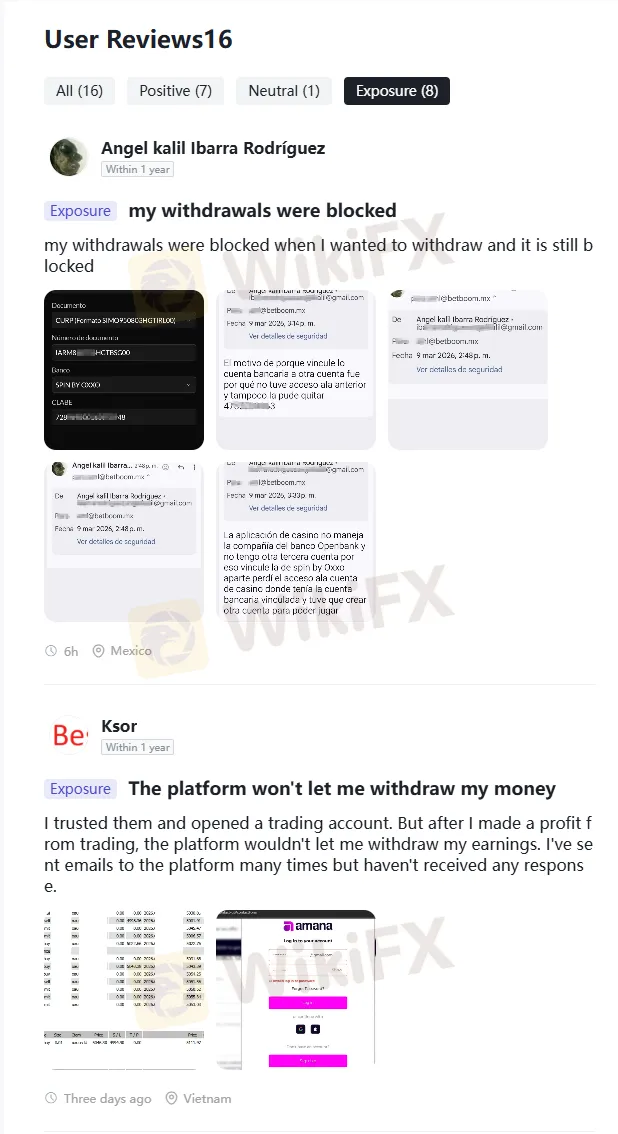
There are also allegations that go beyond standard service frustration. One review says the official website could not be opened in multiple browsers, and another complaint describes being asked to pay personal income tax and a certification fund before withdrawal, ending with the claim that police were contacted.
To stay fair, the review profile is not entirely negative. Positive reviewers praised regulation, spreads, trading signals, order execution, and even normal withdrawals, but repeated user complaints about blocked payouts and account freezes are exactly the kind of warnings traders should not ignore in the WikiFX App.
Trading Setup Does Not Remove Risk
On features alone, amana can look attractive. The account section lists a $50 minimum deposit, the platform section shows MT4 and MT5 full licenses, and the payment section lists Visa, Mastercard, amana Prepaid Card, Apple Pay, wire transfer, UAE instant banking, Neteller, Skrill, Whish Money, and digital currencies.
The page also says traders can enjoy zero fees on card deposits and withdrawals, and the broker summary presents a wide range of tradable markets. Still, good payment options and a low minimum deposit do not cancel out user complaints, especially when the same page also tags the broker with high potential risk.
Final Amana Review Verdict
The clearest conclusion from this source page is that amana sits in a gray area that deserves caution. It has visible regulated licenses, broad platform support, and a sizable product offering, yet the same page highlights too many complaints, multiple exposure posts, and a high-potential-risk warning.
So this is not a clean “safe broker” profile, and it is not accurate to dismiss the warning signs just because regulated entities appear on the page. For traders worried about withdrawal problems, account freezes, and user complaints, the smarter move is to verify the legal entity, start small, and test the withdrawal process before treating amana like a fully trusted funded account destination.
Before you deposit, review the latest alerts, complaints, and license details in the WikiFX App and compare them with the exact amana entity offering your account. That extra step is justified here because the page itself shows both regulatory strength and meaningful risk signals at the same time.