Abstract:Traders looking into a new broker always focus on the basics: how to make a Dbinvesting Deposit and, more importantly, how to complete a Dbinvesting Withdrawal. These are basic questions that need answers. However, with Dbinvesting, there's a more important question to ask first: not *how* you withdraw, but *if* you can withdraw at all. While the broker claims to offer modern payment methods, many user complaints and facts show a troubling picture. There seems to be a big gap between what it promises and what actually happens to real users.
This guide goes beyond its advertising materials. We will look at both its stated procedures for moving funds and what traders actually experience. The goal is to give you a complete, fact-based view so you can make a truly informed decision. Read on!

The Important Withdrawal Question
Traders looking into a new broker always focus on the basics: how to make a Dbinvesting Deposit and, more importantly, how to complete a Dbinvesting Withdrawal. These are basic questions that need answers. However, with Dbinvesting, there's a more important question to ask first: not *how* you withdraw, but *if* you can withdraw at all. While the broker claims to offer modern payment methods, many user complaints and facts show a troubling picture. There seems to be a big gap between what it promises and what actually happens to real users.
This guide goes beyond its advertising materials. We will look at both its stated procedures for moving funds and what traders actually experience. The goal is to give you a complete, fact-based view so you can make a truly informed decision. One important fact shows why this matters: Dbinvesting has an extremely low WikiFX score of 2.15 out of 10. This score is a major warning sign that shows serious problems, and you need to understand the risks before investing. Before depositing any funds, it's important to understand the complete situation. You can check the broker's detailed risk information and user complaints on its WikiFX page.
What It Says About Deposits and Withdrawals
To start, we need to understand the deposit and withdrawal processes as described by Dbinvesting. The broker shows what looks like a convenient and easy-to-use system, designed for people worldwide with multiple payment options. It's important to see this information as a “written promise,” which we will later compare with what users actually experience.
According to the broker's official information, you can make deposits through several methods. The minimum deposit for most methods is a fairly standard $100. The broker also says that it doesn't charge fees for these deposit transactions. The advertised options and their terms are shown below.
While Dbinvesting gives clear details for deposits, information about the Dbinvesting Withdrawal process is less clear. Usually, brokerage firms require withdrawals to be made using the same method as the deposit, as part of standard Anti-Money Laundering (AML) rules. Processing times for withdrawals often depend on internal review and approval, which can make the process take longer than the initial transaction speed. On paper, the system looks functional and follows industry standards. However, the ease of investing is only half the story.
What Really Happens with Withdrawals
This is where the broker's advertised promises are very different from what many traders actually experience. An investigation into the “Exposure” reports filed against Dbinvesting on platforms, such as WikiFX, shows a disturbing and consistent pattern of withdrawal problems. These are not minor delays or isolated customer service issues; they are systematic problems that directly target traders ability to access their funds, especially their profits. By looking at these complaints, we can identify several repeating tactics that the broker reportedly uses.
Pattern 1: Profits Disappear
The most concerning pattern involves completely denying withdrawals and erasing earned profits. Multiple traders have reported that after a period of successful trading, their Dbinvesting Withdrawal requests were not just delayed, but rejected, followed by the arbitrary removal of profits from their accounts.
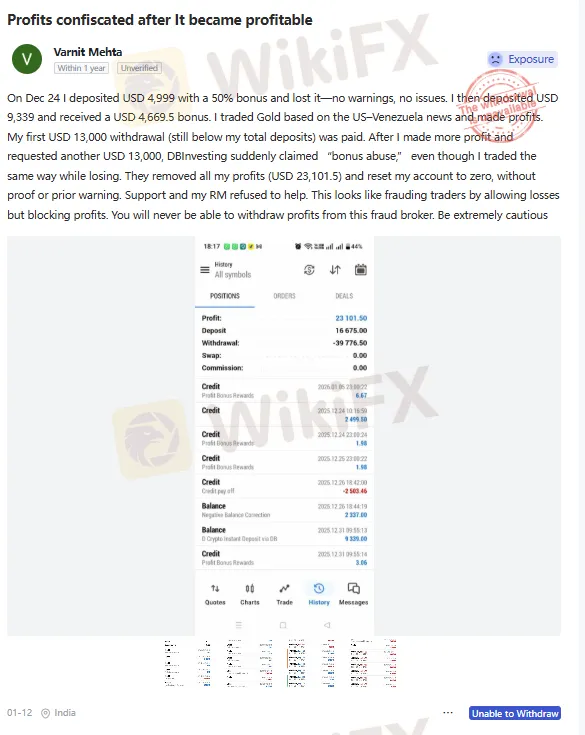
One detailed complaint from 2025 shows this perfectly. A trader deposited $9,339 and, through successful trades, grew their account balance significantly. After making one successful withdrawal, they submitted another request for $13,000. At this point, the broker allegedly accused the trader of “bonus abuse,” a claim made without prior warning or evidence. Then, the broker unilaterally removed over $23,000 in profits, effectively zeroing out the account.
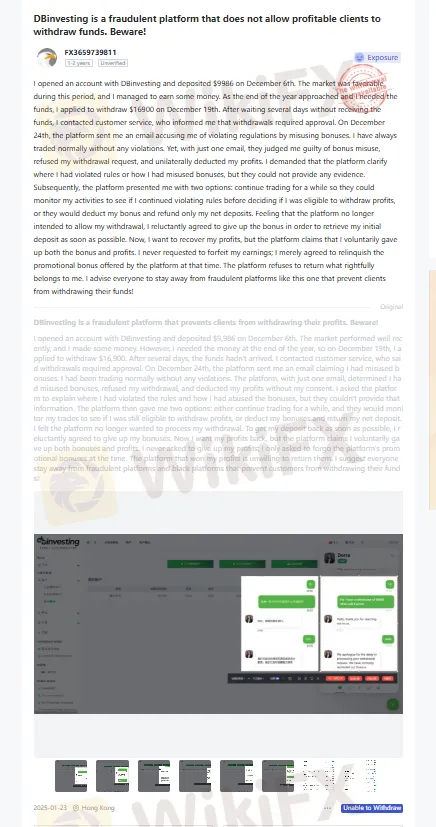
Another user from Hong Kong reported a similar experience. After earning profits and applying to withdraw $16,900, the broker accused them of misusing bonuses. The trader was given a forced choice: either continue trading under scrutiny with no guarantee of future withdrawals, or give up all profits and the bonus just to get their initial deposit back. Feeling trapped, the trader reluctantly agreed to give up their earnings simply to get back their original investment. This tactic of allowing losses but blocking profits appears to be a repeating theme, turning trading into a one-sided risk where any gains are fake.
Pattern 2: Unclear Excuses
A common element in these complaints is the broker's use of vague and unproven excuses to block funds. Terms like “bonus abuse,” “scalping,” “swap abuse,” or using an “autoclicker bot” are frequently used without any supporting evidence.
The trader who was accused of “bonus abuse” pointed out an important inconsistency: their trading method stayed the same during periods of both loss and profit. The accusation only came up after they became profitable and tried to withdraw funds. This suggests the rule is not applied consistently but is instead used as a tool to keep client profits.
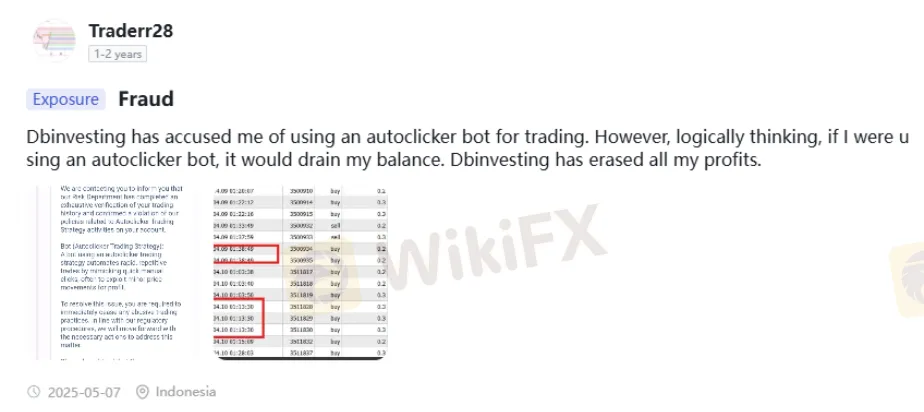
Another user from Indonesia reported having their profits erased after being accused of using an “autoclicker bot,” a claim they denied by pointing out that such a tool would logically drain their balance, not create profit.
These excuses often appear in emails after a withdrawal request is made, catching the trader completely off guard. The lack of transparency and the inability of the broker to provide concrete proof of the alleged violation leave the trader with no options. It creates a situation where the broker acts as judge, jury and executioner, with the trader's profits at risk.
Pattern 3: Blocking and Delays
For traders who aren't immediately accused of violations, a different set of obstacles appears: a deliberate process of blocking, long delays, and a complete lack of clear communication. This pattern aims to frustrate the trader into giving up their withdrawal request.
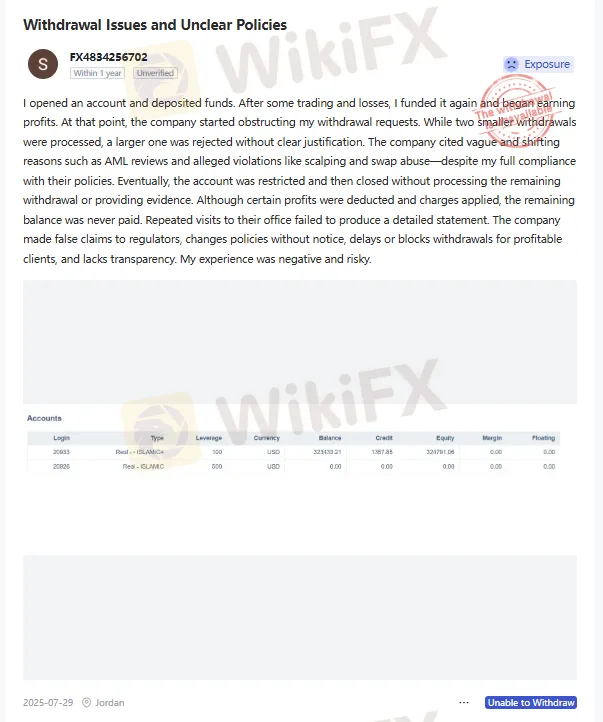
A user from Jordan documented a classic example of this. After successfully making a couple of smaller withdrawals, their request for a larger amount was rejected. The broker's reasons kept changing, shifting from “AML reviews” to allegations of scalping and swap abuse, none of which were proven. The trader's account was eventually restricted and then closed without the withdrawal ever being processed. Even attempts to get a detailed account statement by visiting their office reportedly failed.
This strategy of “death by a thousand cuts” involves long waiting periods, unresponsive customer service, and circular reasoning. By making the withdrawal process an exhausting and unclear ordeal, the broker increases the likelihood that the trader will either give up or accept a punitive settlement, such as giving up their profits.
These are not isolated incidents. A consistent pattern of withdrawal issues is documented by many traders. We strongly advise you to read these first-hand accounts directly on the Dbinvesting WikiFX page before making a decision.
Understanding Main Broker Risks
The patterns of withdrawal denial are not random acts; they are symptoms of deeper, structural problems with the broker's operational and regulatory framework. To protect your investments, it's important to understand *why* these issues are so common and why they pose such a significant threat. An expert analysis reveals several fundamental warning signs.
Offshore Regulation Dangers
Dbinvesting is regulated by the Seychelles Financial Services Authority (FSA). This is classified as “offshore regulation,” which provides a fundamentally lower level of trader protection compared to top-tier regulators like the FCA (UK), ASIC (Australia), or CySEC (Cyprus).
Offshore regulators often have less strict requirements for capital reserves, operational transparency, and dispute resolution. Importantly, their enforcement power is limited, and they offer little to no help for international clients who face issues such as withdrawal refusals. If a dispute arises with an offshore-regulated broker, a trader in Europe, Asia or the Americas has virtually no effective legal or regulatory path to get their funds back. It is like having a security guard with limited authority who cannot act outside a small, designated area. This weak regulatory environment creates a space where brokers can operate with minimal accountability, making it a high-risk proposition for traders.
Important WikiFX Warnings
Third-party risk assessment platforms provide an objective measure of a broker's trustworthiness. The data on Dbinvesting from WikiFX is clear and serves as an important warning.
· Low Score: The broker has a verified score of just 2.15 out of 10. This is an extremely low rating, placing it in the highest-risk category of brokers. A score this low typically indicates severe, unresolved issues across multiple areas, including regulation, business practices, and user experience.
· Direct Warning: WikiFX issues an explicit and clear warning on the broker's profile: “Warning: Low score, please stay away!” This is the platform's most direct form of caution, reserved for entities that pose a significant risk to investors.
· Complaint Volume: As of early 2026, WikiFX has received 14 user complaints against Dbinvesting. While the number may seem small by itself, the severity and consistency of these complaints—focusing on withdrawal denial and profit erasure—point to a systematic problem rather than isolated incidents.
No Verifiable Presence
A legitimate financial services company maintains a verifiable physical presence. This demonstrates operational substance and provides a point of accountability. WikiFX conducted field surveys to verify Dbinvesting's listed office addresses and the findings are another major warning sign. For the broker's listed addresses in both Cyprus and Egypt, the survey result was “No Physical Presence Found.”
While an office was found at its registered address in Seychelles, this is a common requirement for offshore registration and does not imply a significant operational headquarters. The inability to verify operational offices in other key locations, such as Cyprus, is highly concerning. It suggests that the broker may be little more than a digital facade, lacking the physical infrastructure and staff to support a legitimate, global operation. This lack of a tangible footprint makes accountability nearly impossible.
Final Verdict on Reliability
The evidence presents a stark and troubling contrast. On one hand, Dbinvesting advertises a modern, accessible platform with seamless Dbinvesting Deposit and withdrawal capabilities. On the other hand, a mountain of evidence—from detailed user complaints to objective risk analysis—points to a high-risk operation where the withdrawal of funds, especially profits, is fundamentally unreliable.
The core risk factors are severe and cannot be ignored: a weak offshore regulatory license from the Seychelles FSA that offers virtually no protection to international traders; a critically low safety score and explicit warnings from risk assessment platforms; and a documented pattern of blocking withdrawals, erasing profits, and using unsubstantiated excuses to retain client funds. Furthermore, the lack of a verifiable physical presence in key listed locations erodes any claim to operational legitimacy.
While depositing funds into a Dbinvesting account may be easy, the evidence overwhelmingly suggests that this is a one-way street. The risk of being unable to withdraw your capital and profits is not just a possibility; it appears to be a systematic feature of the broker's business model, as reported by numerous users.
Given the overwhelming evidence of withdrawal issues and the broker's high-risk profile, we cannot recommend depositing funds with Dbinvesting. To protect your capital, we urge you to review all the evidence on the official Dbinvesting page on WikiFX and consider well-regulated alternative brokers.
For more such insightful forex updates, visit the WikiFX app. Download now!