

Global Broker Regulation Inquiry App
About WikiFX
English
简体中文
繁體中文
English
Pусский
日本語
ภาษาไทย
Tiếng Việt
Bahasa Indonesia
Español
हिन्दी
Filippiiniläinen
Français
Deutsch
Português
Türkçe
한국어
العربية
اردو


RM890,000 Lost in Days: Two Penang Directors Fell Prey to Sophisticated Scams

WikiFX
|


Abstract:Two company directors in Penang have suffered significant financial losses after falling victim to separate but highly convincing scam operations. The combined losses amounted to RM890,837.91!
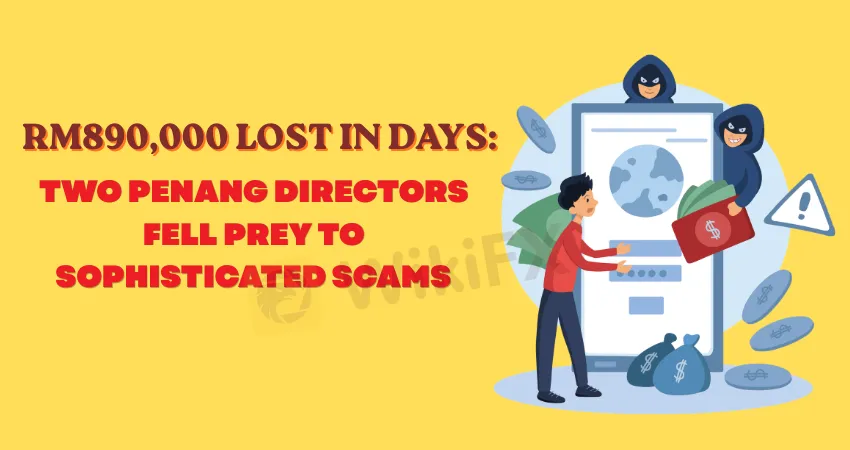
Two company directors in Penang have suffered significant financial losses after falling victim to separate but highly convincing scam operations. The combined losses amounted to RM890,837.91, according to local authorities.
The incidents, reported on 26 March, involved a 69-year-old female director and a 47-year-old male director. Both individuals were deceived through carefully planned schemes in which perpetrators posed as trusted figures, including government officials and business associates.
Penang police chief Azizee Ismail confirmed that both cases are under investigation for cheating under Section 420 of the Penal Code. He outlined how each victim was manipulated through different approaches, yet both scams relied heavily on trust, urgency, and fear.
In the first case, the elderly female director lost RM457,607 after being targeted in a phone scam involving impersonation of authorities. The incident began on 1 March, when she received a call at her home in Simpang Ampat. The caller claimed to represent the Malaysian Communications and Multimedia Commission and alleged that her bank account had been linked to a criminal investigation.
The victim was instructed to file an online police report and was subsequently connected to another individual posing as a senior police officer from Bukit Aman. The scammers escalated the situation by accusing her of involvement in serious crimes, including money laundering and drug trafficking. They also claimed that an arrest warrant had been issued against her.
Under pressure and fearing legal consequences, the victim was persuaded to comply with instructions to assist in what she believed was an official investigation. She provided her banking details and withdrew substantial sums of money. The funds were handed over in two separate transactions (RM168,477 on 11 March and RM289,130 on 13 March) to unknown individuals in Taman Tambun Indah.
Authorities noted that the suspects continued to demand further payments, which eventually raised the victims suspicions and led her to realise she had been deceived.
In a separate incident, the 47-year-old male director lost RM433,230.91 in an investment scam that exploited professional trust and international business connections. On 24 March, he received a message from an individual posing as a known foreign associate, offering an opportunity to participate in a company acquisition in Hong Kong.
The scheme quickly escalated with the victim being contacted through WhatsApp and email by another suspect claiming to be a lawyer from a London-based firm. The use of multiple communication channels and credible identities reinforced the illusion of legitimacy.
Believing the transaction to be genuine, the victim transferred the full amount to a Hong Kong bank account on the same day. It was only after he verified the opportunity with the actual associate that he discovered the deal was fraudulent.
These cases reflect a broader trend in financial scams where criminals employ increasingly complex methods to exploit victims trust. The use of impersonation, combined with urgent demands and detailed narratives, continues to prove effective, even among experienced professionals.
Authorities have urged the public to exercise caution when receiving unsolicited calls or messages, particularly those involving financial requests or investment opportunities. Individuals are advised to verify the identity of callers and consult official channels before taking action.
Disclaimer:
The views in this article only represent the author's personal views, and do not constitute investment advice on this platform. This platform does not guarantee the accuracy, completeness and timeliness of the information in the article, and will not be liable for any loss caused by the use of or reliance on the information in the article.
WikiFX Broker
Latest News
BX Trade Review: Is This Unregulated Broker Worth the Risk?
WikiFXSTMARKET Review: Withdrawal Complaints Cloud a Low-Rated Broker, What to Know Before You Deposit
WikiFXWhy the Dollar Moves Almost Every Forex Pair
WikiFXCONSOB Orders Blocking of 24 Unauthorized Investment Websites
WikiFXBitDelta Receives UAE Category 5 Licence for Introducing Activities
WikiFXRinggit Gains on Majors but Slips vs US Dollar Ahead of Fed
WikiFXtrading.com Review: FCA-Regulated, But Withdrawal Complaints Persist
WikiFXDeriv Review: What Traders Should Know Before Depositing
WikiFXDollar Steadies as Rupee Finds Market Support
WikiFXPRIME VEST SAFE Review: Is Your Deposit Safe?
WikiFX