Abstract:If you're thinking about trading with Dbinvesting, you're probably asking yourself an important question: Is Dbinvesting safe or scam? You've likely seen its appealing offers—the ability to trade with borrowed capital, bonus payments for new accounts, and professional trading software. But something made you pause and search for more information before exposing your capital to risk.
This detailed 2026 review will give you straight facts, not easy answers. We'll examine what real users say about Dbinvesting, especially focusing on Dbinvesting complaints about getting funds out of accounts. We'll compare what the company promises against what actual customers have experienced, so you can make a smart decision about whether to trust them with your capital.
If you're thinking about trading with Dbinvesting, you're probably asking yourself an important question: Is Dbinvesting safe or a scam? You've likely seen its appealing offers—the ability to trade with borrowed capital, bonus payments for new accounts, and professional trading software. But something made you pause and search for more information before exposing your capital to risk.
This detailed 2026 review will give you straight facts, not easy answers. We'll examine what real users say about Dbinvesting, especially focusing on Dbinvesting complaints about getting funds out of accounts. We'll compare what the company promises against what actual customers have experienced, so you can make a smart decision about whether to trust them with your capital.
Warning Signs to Watch Out For
When choosing any trading company, you need to check three main things: whether it is properly supervised by financial authorities, how other industry experts rate them, and whether they're honest about their business. These aren't just paperwork details—they tell you if your capital will be safe. When we look at Dbinvesting using these standards, we find several serious problems that anyone thinking about investing should understand first.
What “Offshore Regulation” Really Means
Dbinvesting is run by a company called DB Invest LIMITED. It has permission to operate from the Seychelles Financial Services Authority (FSA), with license number SD053. While this means it is technically “regulated,” it's important to understand what this type of regulation actually protects.
Not all financial regulators are the same. The best regulators, like those in the UK or Australia, have strict rules about keeping customer funds separate from company funds, making sure companies have enough backup funds, and helping solve problems when they arise. These regulators create strong legal protection for investors.
Regulators in places such as Seychelles typically offer much weaker protection. They don't watch companies as closely, have looser rules, and give traders very limited ways to get help if something goes wrong. For a trader, this means that if the company decides to keep your funds or does something questionable, getting your funds back can be extremely difficult or even impossible. Companies often choose these locations specifically because they face less oversight.
Concerning 2.15 Out of 10 Rating
Industry rating websites give numerical scores to show how reliable trading companies are. According to WikiFX, Dbinvesting has a very low score of 2.15 out of 10. A score this low is a serious warning in the financial industry. It suggests major problems that go far beyond small customer service issues.
The website clearly explains why the rating is so low: “The WikiFX Score of this broker is reduced because of too many complaints!” This directly connects the poor score to a pattern of unhappy customers. The warnings are clear: “Warning: Low score, please stay away!” and a label of “High potential risk.” This score isn't random—it's based on real data from documented problems reported by users.
Checking Physical Offices
Whether a company has real offices can tell you about how substantial and honest it is. WikiFX sends people to check the addresses that trading companies claim to operate from. The results for Dbinvesting show a mixed and worrying picture.
· Seychelles: The WikiFX team found an office at the listed address: Room B11, First Floor, Providence Complex, Providence, Mahe.
· Cyprus: The investigation found: No Physical Presence Found.
· Egypt: The investigation also found: No Physical Presence Found.
While it did find the Seychelles office, the lack of real offices at other locations it claims to operate from, especially in important areas like Cyprus, raises questions about how honest the company is about its operations. This difference between claimed addresses and actual, confirmed offices can be a warning sign for traders looking for a company with transparent and solid operations.
To see complete information about Dbinvesting's regulatory status and full office investigation reports, check its detailed profile on WikiFX before making any decisions.
Looking at Real Customer Problems
Beyond ratings and regulation, the strongest evidence comes from actual traders. Looking at the 14 customer complaints filed on WikiFX shows not just random problems, but repeating patterns of behavior. These patterns clearly show the specific risks traders might face, especially when they start making returns. Rather than just a random list of complaints, we've organized these problems to highlight the tactics that users worldwide repeatedly report.
When Making Returns Becomes a Problem
A disturbing pattern appears in user reports: problems start when traders become profitable. In this situation, a trader's experience with Dbinvesting goes smoothly as long as they're losing funds or only taking out small amounts. The problems begin the moment they make significant profits and try to withdraw their earnings.
One user from Jordan, identified as FX4834256702, describes exactly this experience. After initial losses and putting in more funds, they began making profits. That's when the company allegedly started blocking withdrawals. The user states:
> “While two smaller withdrawals were processed, a larger one was rejected without clear justification.”
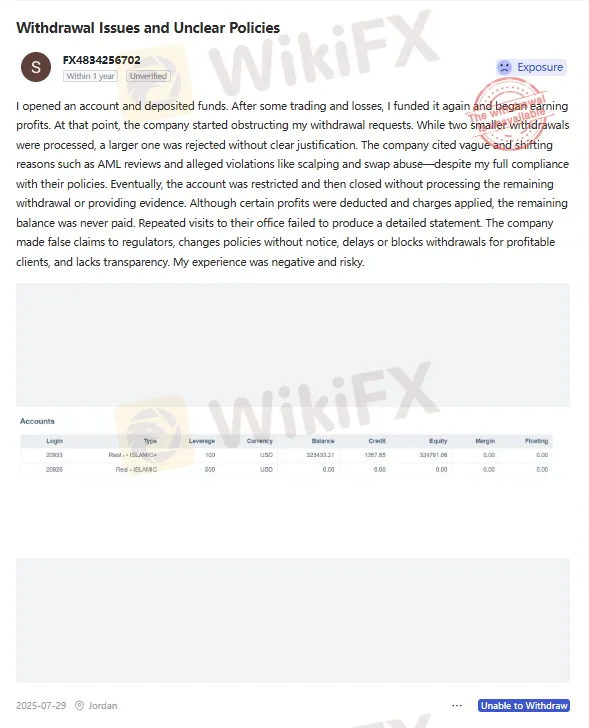
This tactic of processing small withdrawals to create false confidence, only to block larger profit withdrawals, is a classic warning sign.
Another user, Varnit Mehta from India, reports almost the same story. He successfully withdrew $13,000 (which was still less than his total deposits). However, after making more profit and requesting another withdrawal, the problems began.
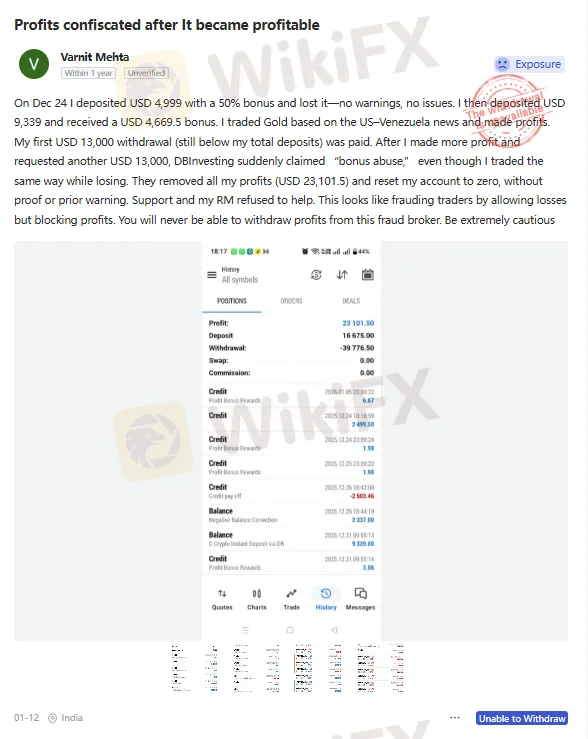
This pattern suggests a planned strategy to keep client profits while allowing initial deposit withdrawals to maintain an appearance of legitimacy.
Using “Bonus Abuse” as an Excuse
Another repeating theme is using “bonus abuse” as a reason for taking away profits. Several users report that after trading successfully, they were suddenly accused of breaking rules related to promotional bonuses, often without any proof provided by the company.
User FX3659739811 from Hong Kong provides a detailed account of this pattern. After depositing nearly $10,000 and earning a profit, they applied to withdraw $16,900. The platform then sent an email accusing them of “violating regulations by misusing bonuses.” The user insisted they traded normally and, when they demanded proof of the violation, the company could not provide any. Dbinvesting allegedly took away all the profits, offering to return only the initial deposit.
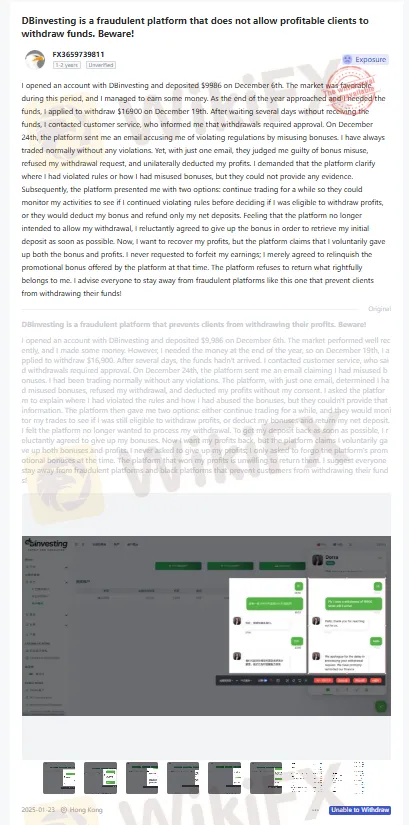
Varnit Mehta's case also fits this pattern. He was accused of “bonus abuse” only after he became profitable, despite using the same trading strategy that resulted in losses earlier, during which the company had no problem. This inconsistency strongly suggests that the “bonus abuse” claim is not genuine rule enforcement but rather an excuse used to take profits from successful traders.
Changing Rules and No Clear Explanations
A third major pattern of complaints involves a complete lack of transparency and the use of changing, unproven reasons for blocking funds. Traders report being accused of various rule violations without ever receiving concrete proof or a clear explanation.
User FX4834256702 from Jordan describes this tactic clearly:
> “The company cited vague and shifting reasons such as AML reviews and alleged violations like scalping and swap abuse—despite my full compliance with their policies.”
This user adds that their account was eventually closed without the remaining balance being paid out, and repeated visits to the office failed to yield a detailed statement.
Another user, Traderr28 from Indonesia, was accused of using an “autoclicker bot”—a claim the user found illogical—which resulted in all their profits being erased.
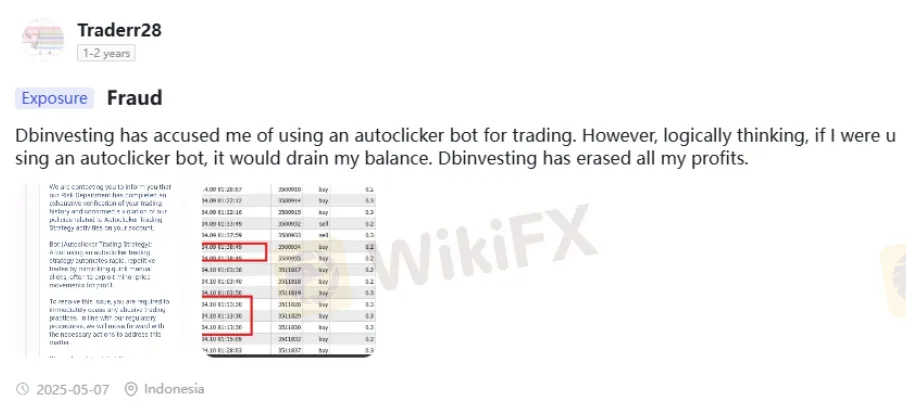
In these cases, the company acts as judge, jury, and executioner, making accusations and imposing penalties without a transparent process or providing evidence to support its claims.
For clarity, these documented patterns can be summarized as follows:
The Other Side of the Story
To give you a complete and fair analysis, it's important to mention that not all feedback about Dbinvesting is negative. Some positive reviews exist, and they often praise specific parts of the company's service. However, looking carefully at these positive comments alongside the serious negative complaints is essential. This helps us understand the complete picture and make sense of the mixed signals a potential customer might see.
What People Like About Dbinvesting
Positive reviews for Dbinvesting often highlight a few main themes. Looking at these gives us insight into what the company does well, at least for some users at some point in their trading experience.
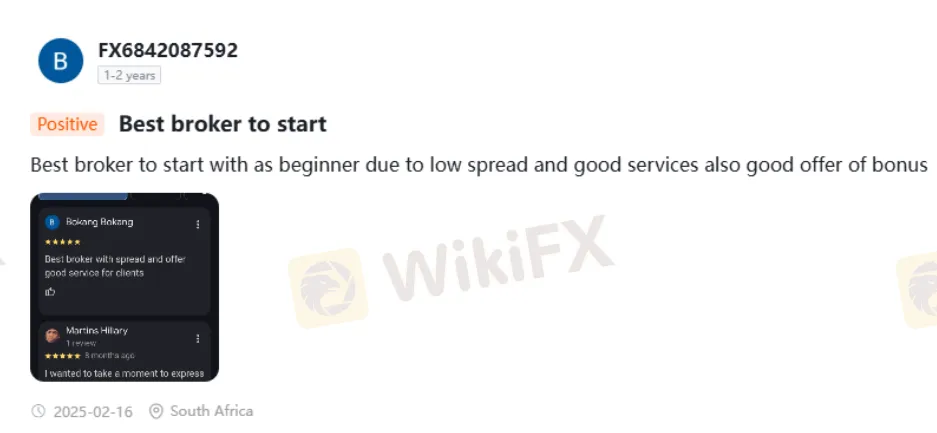
· Bonuses and Promotions: Several users, including FX1974479262 and FX6842087592, praise the company for providing good bonuses and promotional offers.
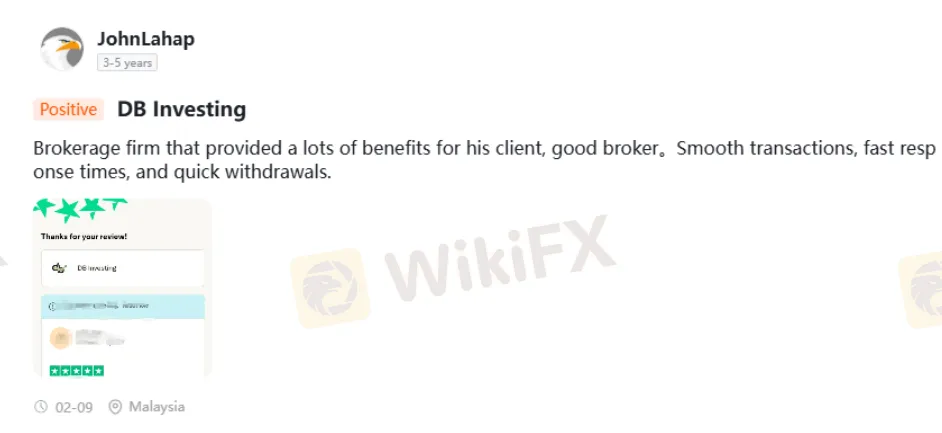
· Transaction Speed: Users like JohnLahap and FX2750451702 report “smooth transactions” and “fast withdrawals.” This completely contradicts the numerous complaints about blocked funds.
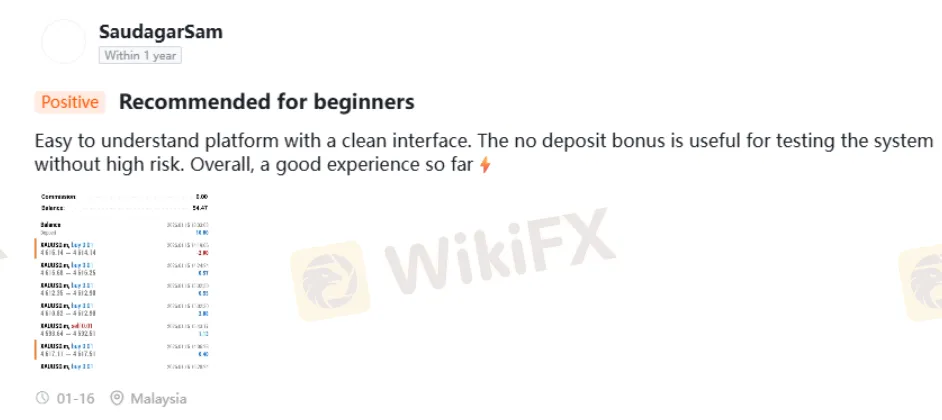
· Platform Usability: The trading platform itself receives praise. SNR HUNTERS notes “fast execution,” and SaudagarSam appreciates the “easy to understand platform with a clean interface.”

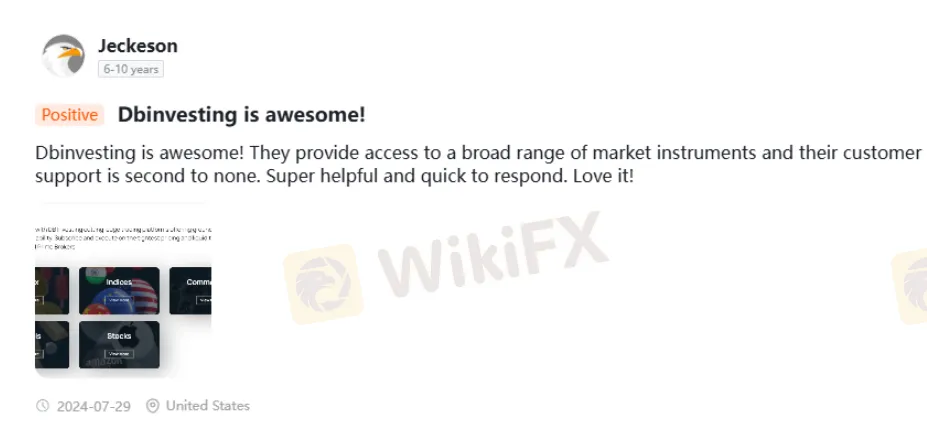
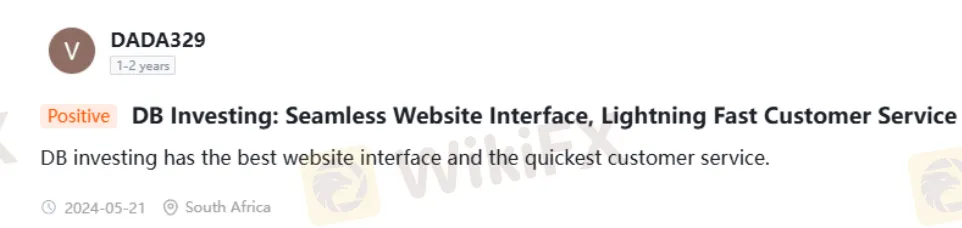
· Customer Service: Some users, such as Jeckeson and DADA329, report positive experiences with customer support, describing it as “super helpful and quick to respond.”
Looking at This More Carefully
While this positive feedback seems encouraging at first, a careful analysis requires putting it in the right context. The key question is: what situation are these positive reviewers in? Are these new traders? Have they tried to withdraw significant profits, or only their initial deposit?
The negative complaints are overwhelmingly specific: the problems happen when withdrawing profits. Many positive reviews may come from traders in a “honeymoon phase”—they have just invested, are enjoying how easy the platform is to use, and may have successfully withdrawn a small amount or their initial capital. This fits perfectly with the “Profit Paradox” pattern, where the company appears legitimate until the trader becomes a net winner.
Furthermore, the frequent praise for bonuses is itself concerning. As seen in the negative reports, these same bonuses are later used as an excuse to accuse traders of “bonus abuse” and take away their earnings. The appeal of a bonus may be attracting positive initial reviews, but it also appears to be a central part of a system for keeping client profits later on.
The stark difference between positive and negative reviews is a major red flag. To see the full, unfiltered list of user exposure reports and draw your own conclusion, review the evidence on Dbinvesting's WikiFX page.
The Final Answer
After thoroughly examining Dbinvesting's regulatory status, industry rating and the repeating patterns found in both positive and negative user feedback, we can now put together the evidence to provide a clear answer. The main question is not just whether the platform works, but whether it is a safe place for your funds, especially your profits.
Comparing Promises to Reality
To make the final judgment clear, we can place the company's advertised features and positive claims directly against the reality documented in user complaints and objective data. This side-by-side comparison reveals a fundamental disconnect between what is promised and what is often delivered.
Conclusion: A High-Risk Company
Based on the overwhelming evidence from verified sources as of 2026, our conclusion is clear. While Dbinvesting may not be a “scam” in the simple sense of a platform that disappears with initial deposits, it shows a clear, documented, and repeating pattern of behavior that actively prevents profitable traders from accessing their earnings.
This behavior, combined with the weak protection offered by its offshore regulation and an extremely low trust score of 2.15/10, places Dbinvesting squarely in the high-risk category for any serious trader. The risk here is not just the normal risk of trading the markets; it is the additional, unacceptable risk of having your winning trades taken by the company itself. Successful trading is difficult enough without having to worry if your trading company will honor its promises. The evidence suggests that with Dbinvesting, this is a significant and real concern.
The decision is ultimately yours, but trading involves managing risks. The first risk to manage is the safety of your trading company. We strongly advise every trader to personally verify the information and read all user complaints on the Dbinvesting WikiFX page.