


Global Broker Regulation Inquiry App
About WikiFX
English
简体中文
繁體中文
English
Pусский
日本語
ภาษาไทย
Tiếng Việt
Bahasa Indonesia
Español
हिन्दी
Filippiiniläinen
Français
Deutsch
Português
Türkçe
한국어
العربية
اردو
Why Judging Trades by Profit Teaches the Wrong Lesson
Abstract:Beginner traders often evaluate their success based solely on whether a position made money, ignoring the flawed processes that may have led to the result. This psychological trap, known as outcome bias, can cause investors to reinforce bad habits and treat the market like a casino. The main takeaway is to judge your trading strategy using statistical data and backtesting rather than the emotional result of a single trade.
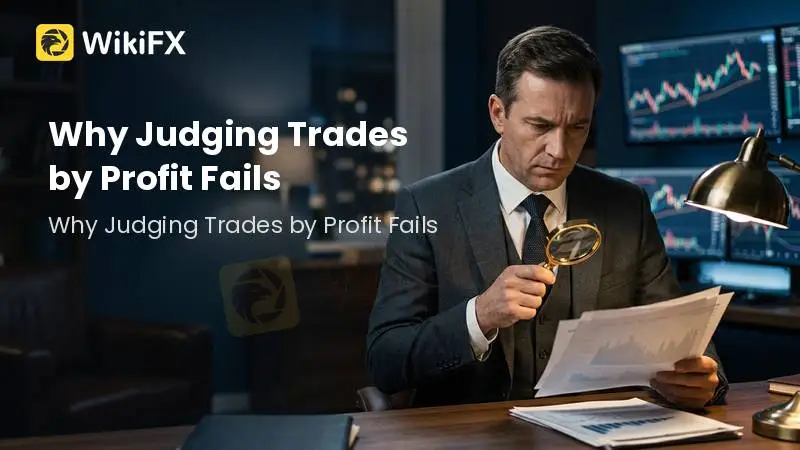
Many beginner Forex investors in Malaysia assess their daily performance with one simple question: did the trade make money? If the position closes in profit, they feel they made a brilliant decision. If it hits the stop-loss, they assume they failed.
While this sounds logical enough, it is actually one of the most dangerous mental traps in the financial markets. It is a psychological flaw known as outcome bias.
 Contents
What Exactly is Outcome Bias?
Outcome bias occurs when you evaluate a decision solely based on the final result, completely ignoring the process and the market events that led up to it.
For instance, imagine you hear a colleague made a massive return investing in real estate. Driven by this outcome, you decide to throw your capital into property, ignoring the fact that your colleague bought years ago when interest rates were entirely different. You focused only on the money made, not the underlying variables that drove the success.
In the retail trading world, falling for outcome bias is treating the market like a casino. Just as gamblers justify staying at the table based on anecdotal stories of massive wins, beginners justify poor trading habits because they survived a bad trade. If you risk far too much margin on a single pair and the market randomly spikes in your direction, you might feel like a successful trader. In reality, you just got away with a terrible decision.
As performance becomes the only metric you care about, bad habits take root. In the broader business world, ethical lapses or flawed operations are often overlooked as long as the immediate outcome is successful. On the charts, breaking your own risk management rules is easily ignored the moment you secure a profit.
The Danger of Mechanical Mistakes
A perfect example of how outcome bias warps a trader's reality is the transposition error. In finance, a transposition error happens when someone accidentally reverses two adjacent digits when recording data or placing an order.
On trading desks, this is commonly called a “fat-finger trade.” A famous historical example involved a Japanese trader who accidentally placed an order for 1.9 billion shares of Toyota simply by typing the wrong numbers onto the screen.
Imagine you meant to open a 0.10 lot position but suffered a fat-finger mistake and entered 1.00 lot instead. If the currency pair suddenly crashes against you, your account risks being wiped out. But if the market moves in your favor, you make ten times the profit you initially expected. Outcome bias will make you feel thrilled with the massive return, severely downplaying the fact that a simple typing error almost destroyed your entire balance. You end up praising the outcome rather than fixing the severe risk in your execution.
A Better Approach
To survive your first few years in the markets, your decisions must rely on evidence, not the emotional high of a single outcome. Instead of outcome bias, you should evaluate your strategy using a statistical concept called hypothesis testing.
Hypothesis testing is a structured method where you test a mathematical assumption by examining a broad sample of data. It helps you avoid false claims and completely separates true market patterns from mere coincidence.
The framework is straightforward:
1. State your assumption (for example, “Buying when price hits this specific support level generates a positive return”).
2. Formulate a plan to evaluate historical market data.
3. Analyze a large sample size of past trades.
4. Interpret the results to see if the trading strategy holds up over time.
By relying on hypothesis testing across dozens or hundreds of trades, you eliminate the emotional noise of a stand-alone win or loss. You build a robust system for making informed conclusions, proving whether your edge is actually real or just random luck.
Focus on the Process
Do not let a lucky win or an execution mistake dictate how you trade tomorrow. A profitable outcome does not automatically mean you made a good decision, and a loss does not mean you traded poorly.
Part of maintaining this process-driven mindset is securing your foundational risks. Before you test any strategy with real capital, ensure your funds are deposited with a transparent provider. You can use the WikiFX app to verify your chosen brokers regulatory background and license details. By confirming your platform is secure from the start, you can fully dedicate your energy to tracking your trading data, avoiding outcome bias, and executing your strategy with precision.

Disclaimer:
The views in this article only represent the author's personal views, and do not constitute investment advice on this platform. This platform does not guarantee the accuracy, completeness and timeliness of the information in the article, and will not be liable for any loss caused by the use of or reliance on the information in the article.
WikiFX Broker
Latest News
CNMV Warns Against 10 Unauthorized Investment Platforms and Clone Firms
 WikiFX
Dollar Steadies As US Inflation Reaches 4.20%
WikiFXFrom Demo to Real Money: Overcoming the Fear of Holding Your First Live Trade
WikiFXWhy Market News and Spread Shocks Sweep Your Stop Loss
WikiFXHow to Place a Forex Stop Loss Using Market Volatility
WikiFXWhy Weekend Market Gaps and Swaps Destroy Beginner Accounts
WikiFXDollar Slips on Easing Middle East Tensions
WikiFXInstaForex Review 2026: Unverified Regulation, Complaints, and High-Leverage Risk
WikiFXMing Tak Review 2026: Regulation, Complaints, and Platform Access
WikiFXCrypto Scam Call Centre Dismantled in Penang as Authorities Intensify Fight Against Cross-Border Fra
WikiFXCurrency Calculator
USD

CNY
Current Rate:0
Enter amount
USD
Redeemable Amount
CNY
Calculate 